


Blog
Materials that Matter: Choosing Durable Cleaning Tools That Last

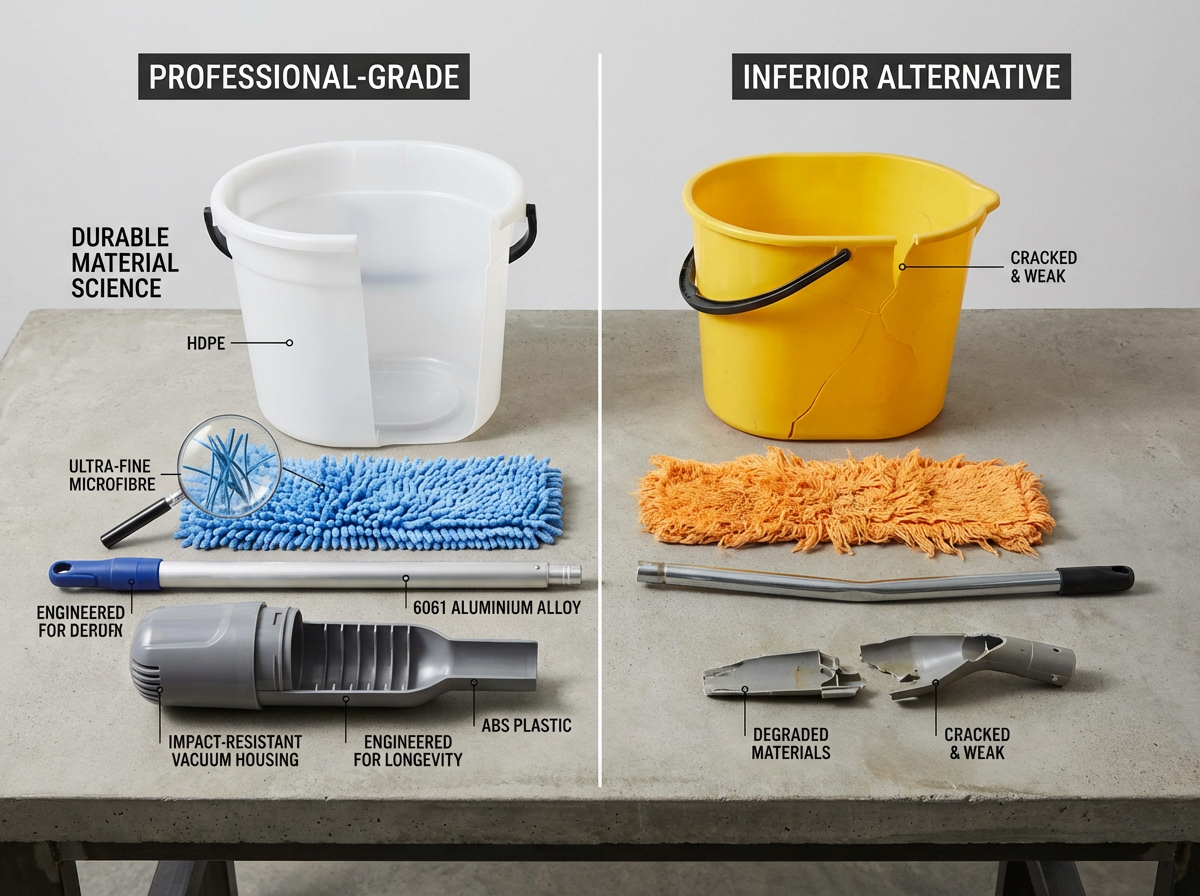
When selecting durable cleaning tools for commercial facilities or homes that demand professional-grade results, the material composition determines whether you’ll replace them in six months or six years. Many facilities managers have invested in what appeared to be cost-effective equipment, only to watch handles snap, mop heads disintegrate, and squeegee blades perish within weeks. The difference between a tool that endures and one that fails isn’t always obvious at purchase, but it becomes painfully clear when replacements are ordered every quarter.
Durable cleaning tools aren’t just about longevity – they’re about consistent performance under demanding conditions. A mop that maintains absorbency after hundreds of washes, a squeegee that still delivers streak-free windows after months of use, or a bucket that doesn’t crack when filled with hot water in winter. These aren’t luxury features; they’re baseline expectations when you understand what separates professional-grade equipment from consumer alternatives.
At Weskleen Supplies, every product in our inventory is selected for proven performance in real-world conditions. Each piece of equipment is designed to endure heat, moisture, pressure, and chemical exposure while maintaining its integrity and effectiveness.
Why Material Selection Defines Tool Performance
The cleaning industry has a direct relationship with material science. Tools face constant exposure to water, chemicals from acidic descalers to alkaline degreasers, physical stress from repetitive motion, and environmental factors such as UV exposure and temperature fluctuations. Materials that perform well in controlled conditions often fail quickly in real-world environments.
Take a typical plastic mop bucket as an example. Consumer-grade polypropylene might handle mild detergents and cold water, but add a hot alkaline solution or leave it in sunlight and you’ll soon see warping or cracking. Professional-grade buckets use high-density polyethylene (HDPE) or reinforced polypropylene engineered for temperature stability and chemical resistance. The price difference might be 40%, but the performance gap is far greater.
From our field experience across Perth facilities, properly engineered materials last three to five times longer. A facility spending $200 annually on replacement mop heads can reduce that to $60 simply by selecting microfibre blends that tolerate industrial laundering.
Stainless Steel vs Aluminium in Extension Poles
Extension poles highlight how materials influence comfort, control, and corrosion resistance. When cleaning high windows, solar panels, or façades, material choice directly affects fatigue, handling, and tool lifespan.
Aluminium poles offer excellent strength-to-weight ratios, ideal for overhead work. Yet not all aluminium is equal – extruded aluminium with the correct wall thickness resists bending, while cheaper versions flex excessively, making control difficult. The Ettore 5.5 m Extension Pole uses aircraft-grade aluminium with reinforced locking collars. After years of daily use, its stainless steel locking pins show no major wear – eliminating the usual weak point of cheaper plastic tabs.
Stainless steel poles excel in coastal environments where salt accelerates oxidation. They’re heavier but offer superior corrosion resistance and better downward pressure for scrubbing. For facilities within 10 kilometres of the ocean, stainless steel often delivers better lifetime value despite the higher purchase cost.
Microfibre Technology and Synthetic Blend Durability
The shift from cotton to microfibre revolutionised professional cleaning, but not every product delivers the promised performance. Quality microfibre combines polyester and polyamide fibres split into microscopic hooks and channels that trap dirt and moisture more effectively than cotton. Inferior products skip or poorly execute this splitting process, leading to fibres that mat and lose absorbency after only a few washes.
Premium mop heads like the Enduro Microfibre Mop Head use an 80/20 polyester-polyamide blend with fibres split to 0.1 denier – one-sixteenth the diameter of human hair. These mop heads withstand 300–500 wash cycles while retaining their absorbency. In commercial use, we’ve seen them laundered twice weekly and still effective after 18 months.
Proper care extends microfibre life:
- Avoid fabric softeners, which coat fibres.
- Don’t use bleach; it degrades polyamide.
- Wash below 60 °C to prevent melting or deformation.
These are not optional suggestions but operational necessities if you want long-term performance.
One Perth café switched from budget cotton mops to professional microfibre ones after struggling with streaks and odours. Within weeks, cleaning time dropped by 30% and the floors dried faster, reducing slip hazards during service. Sometimes, the simplest material upgrade changes the entire workflow.
Rubber Compounds in Squeegees and Weather Resistance
A squeegee’s effectiveness lies in its blade material. Natural rubber provides flexibility and clean edges but deteriorates quickly under UV and cold exposure. Synthetic rubbers such as neoprene or proprietary blends maintain flexibility across –20 °C to 50 °C and resist ozone and sunlight degradation.
Outdoor window cleaning in Perth demonstrates this clearly: natural rubber blades lose elasticity within three months, while neoprene blades stay effective for up to two years. The durometer (hardness) also matters. A Shore A rating of 65–75 offers the best balance between flexibility and rigidity. Softer blades wear faster; harder ones struggle on uneven surfaces.
For reliable results, choose professional blades engineered for consistent contact and durability. Quality tools reduce both rework and waste, which directly impacts operational efficiency.
Handle Construction and Ergonomic Material Choices
Handles are the user’s interface with every cleaning tool. Their construction affects comfort, control, and injury prevention. Fibreglass-reinforced nylon offers high strength, chemical resistance, and low weight. Unlike metal, it doesn’t conduct cold – an advantage in winter or wet environments.
Handles featuring thermoplastic rubber (TPR) grips improve safety and comfort by maintaining friction even when wet. Premium TPR coatings resist degradation and don’t become sticky over time. The Cleaning Hand Caddy combines reinforced polypropylene with TPR-coated handles that remain secure after years of daily use – a small design detail that prevents fatigue during extended shifts.
Bucket and Container Material Engineering
A mop bucket must handle thermal, chemical, and mechanical stress daily. HDPE remains the preferred choice because it resists acids, alkalis, and impact while staying dimensionally stable. Wall thickness is equally critical: professional-grade buckets use at least 2 mm thickness with reinforcement ribs, whereas cheaper versions flex and crack under load.
The 16 L Mop Bucket exemplifies intelligent design. It uses HDPE with reinforced handle mounts and slightly thinner body walls for reduced weight – providing durability where it matters most.
Think of HDPE like the steel frame of a building. The structure might flex slightly under load, but it won’t collapse. Thin consumer plastic, by contrast, behaves like untreated timber – lightweight but prone to splitting under stress.
Vacuum Construction Materials and Filtration Media
Commercial vacuums must balance durability and operator comfort. The Pacvac Superpro 700 Backpack Vacuum uses impact-resistant ABS housing reinforced at key stress points, protecting internal components from daily knocks. After 18 months of heavy use, these units show minimal wear, while consumer vacuums often crack within weeks.
Filtration material is just as vital. Genuine HEPA filters made from borosilicate glass or high-grade synthetics capture 99.97% of particles down to 0.3 microns. Poorly sealed filters allow bypass air, reducing effectiveness. Investing in a professional-grade system ensures cleaner air, longer motor life, and lower maintenance costs.
Explore the full range of professional carpet cleaning machines engineered for longevity and consistent performance.
Chemical Resistance in Spray Bottles and Applicators
Spray bottles face one of the toughest durability challenges. Exposure to concentrated chemicals can quickly degrade plastics and seals if the wrong materials are used. HDPE bottles handle most cleaners, while PETE bottles provide transparency for easy monitoring but limited solvent resistance.
The trigger mechanism is a complex assembly of springs and seals that must withstand chemical attack. Professional-grade sprayers feature stainless steel springs, silicone seals, and reinforced nylon components. In testing, consumer triggers often fail within 300 uses; commercial models exceed 2,000 cycles without leaking.
Durability here isn’t optional – it’s safety-critical. Reliable triggers prevent chemical leaks that can cause injury or cross-contamination.
Floor Scrubber Component Durability
Floor scrubbers represent significant investments, and the materials used in their tanks, brushes, and squeegees determine total ownership cost. Rotomoulded polyethylene tanks offer seamless construction, eliminating weak points that cause leaks. They resist chemical attack and withstand impacts far better than fabricated alternatives.
The Polystar Orbital Floor Scrubber features rotomoulded solution and recovery tanks with 4 mm wall thickness – proven to endure years of use even with aggressive stripping solutions. Its urethane squeegee blades maintain contact and resist wear under continuous operation.
Businesses across Perth rely on Weskleen Supplies for access to scrubbers and components that deliver this level of endurance.
Mop Frame and Handle Material Integration
A mop frame’s longevity depends on its structural design. Aluminium frames provide the best strength-to-weight balance and resist corrosion, while welded joints outperform mechanical fasteners by removing weak points. The frame-to-handle joint is the main stress zone, and quality systems use threaded metal inserts in fibreglass handles for a secure metal-to-metal bond.
Testing shows properly constructed assemblies can handle 3,000 m² of daily cleaning for over two years without loosening. Plastic connectors, by contrast, often fail within months. Choosing robust designs means fewer interruptions and safer operations.
Protective Equipment Material Standards
Protective gear must balance safety, comfort, and durability. Nitrile gloves provide excellent chemical resistance and puncture strength without the allergy risks of latex. Disposable gloves around 4–5 mil thick suit light tasks, while reusable 15–18 mil gloves endure harsher chemicals and extended use, offering far better long-term value.
Chemical-resistant aprons made from PVC or nitrile coatings shield against splashes. PVC is economical and effective for mild chemicals, while nitrile performs better in extreme conditions and remains flexible in the cold. Selecting appropriate PPE materials safeguards both workers and workflow efficiency.
Tool Storage and Material Degradation Prevention
Even the most durable cleaning tools degrade prematurely without proper storage. UV light breaks down plastics and rubbers; temperature extremes cause material stress; moisture promotes corrosion and mould. Where possible, store equipment in controlled environments. When outdoor or vehicle storage is unavoidable, choose tools with UV-stabilised plastics and stainless steel fittings.
Real-world tests show how storage conditions influence durability: squeegees left in direct sunlight cracked within six weeks, while those stored in shaded areas lasted 18 months. Correct storage protects the investment you’ve made in professional-grade materials.
Cost Analysis of Material Quality
Long-term data consistently show that premium materials reduce total ownership costs. A $15 mop head lasting six months costs $30 a year. A $35 professional-grade head lasting 18 months costs just $23 a year. Add reduced downtime and fewer replacement orders, and the savings become even clearer.
Durability isn’t just about longevity – it’s about reliability, consistency, and efficiency. Choosing materials that perform under pressure directly improves safety, productivity, and return on investment.For guidance on selecting long-lasting, professional cleaning tools, feel free to get in touch with the Weskleen team for expert product recommendations tailored to your facility’s needs.