


Blog
Fast-Track Your Team’s Equipment Confidence with Quick Start Guides

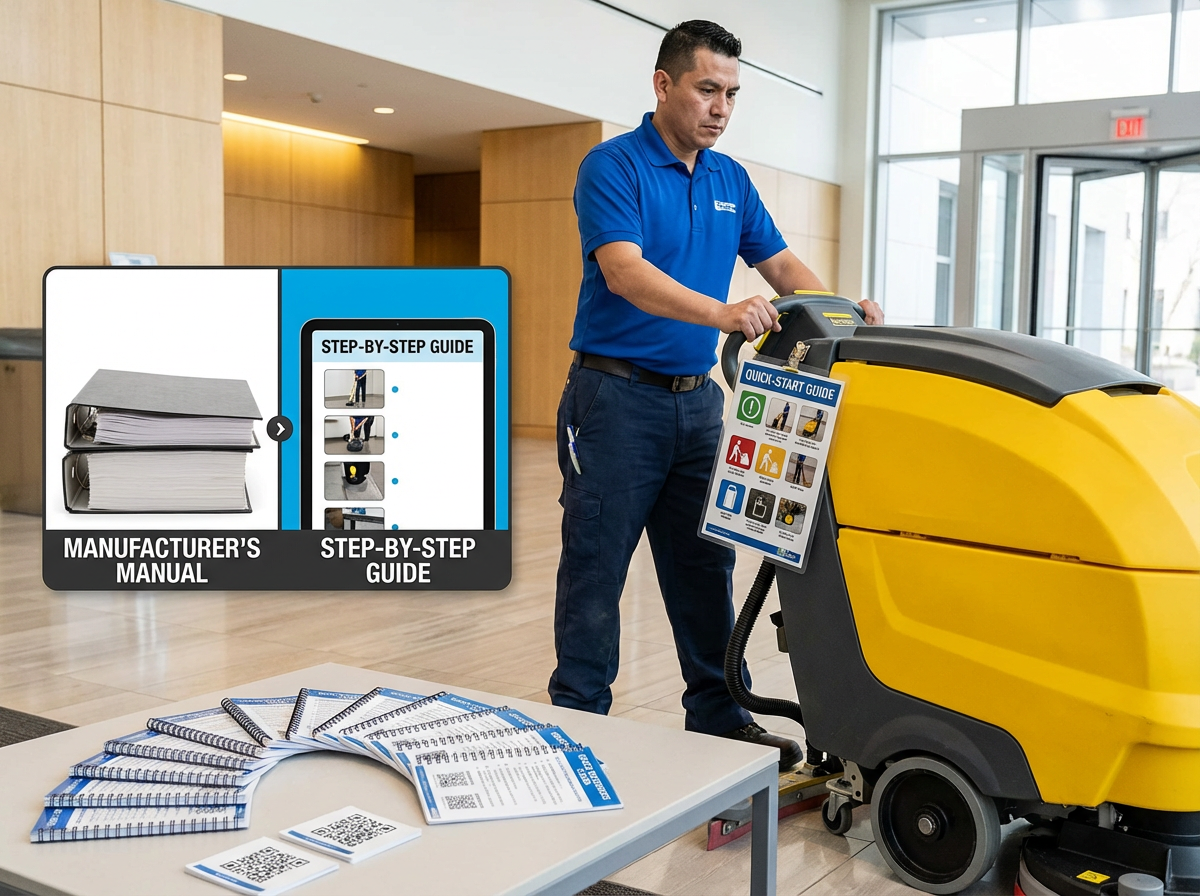
Handing a team member a commercial floor scrubber or backpack vacuum without proper instruction isn’t just inefficient – it’s a liability. Equipment sits idle, jobs take longer, and costly machines are often mishandled simply because users lack practical knowledge on how to adjust brush pressure or empty recovery tanks correctly.
Businesses lose hours of productivity when staff rely on guesswork instead of guidance. Many operators delay using new machines like the Polystar Orbital Floor Scrubber because they seem “too complicated.” That’s not a training failure – it’s a documentation gap.
Equipment training guides fill this gap by providing clear, visual, and easy-to-understand reference materials. These guides aren’t bulky manufacturer manuals – they’re quick, practical resources that help staff operate cleaning machinery confidently and safely from day one.
When staff can refer to a laminated quick-start sheet during their shift and instantly recall the correct dilution ratio or attachment type, they work faster, more safely, and protect the value of professional-grade equipment.
Why Standard Manuals Fail Cleaning Teams
Manufacturer manuals serve a legal purpose, but they’re rarely useful for rapid training. They’re lengthy, highly technical, and designed for compliance, not comprehension.
Cleaning staff don’t need the wattage specifications of a motor when the vacuum loses suction mid-shift – they need to know how to locate and clean the filter in under two minutes.
Visual reference materials drastically improve retention and understanding. A single photo-based guide of the Pacvac Superpro 700 Backpack Vacuum teaches more in minutes than pages of dense technical text.
Manuals also assume a high level of technical vocabulary, which doesn’t reflect the reality of diverse cleaning teams. A simple photo with arrows and plain instructions – for example, “Empty when liquid reaches this line” – is far more effective than complex terminology.
Finally, manuals aren’t built for use during actual work. They’re too long to reference quickly and too generic to cover your team’s specific equipment or environment. Quick-start guides fix this by delivering the essential information right where it’s needed.
Building Guides That Actually Get Used
The most effective equipment training guides share three traits: they’re visual, task-specific, and always accessible.
- Visual: Use photos of your actual machines, not generic diagrams. When staff see the exact Polystar Orbital Floor Scrubber they’re operating, comprehension improves instantly.
- Task-specific: Organise guides around real-world actions like “Starting Your First Clean” or “End-of-Shift Maintenance,” not technical sections like “Parts Overview.”
- Accessible: Design guides that travel with the operator. A Cleaning Hand Caddy with a laminated reference sheet attached ensures information is always within reach.
Keep sentences concise and the reading level practical. “Press the red button to start” communicates far more effectively than complex technical phrasing. Clarity supports confidence.
What Every Equipment Guide Should Include
Every guide should be structured to answer the real questions staff face during work.
1. Pre-Operation Checklist
A checklist prevents downtime and damage.
- For the Pacvac Superpro 700, verify the bag and filter are clean and the cord undamaged.
- For the Pacvac Superpro 700 Battery Kit, ensure batteries are charged and correctly installed.
2. Startup and Shutdown Procedures
List clear, step-by-step processes. Many costly repairs occur because machines aren’t purged or cleaned properly after use. Numbered steps with images make the sequence easy to follow.
3. Common Mistakes and How to Avoid Them
Highlight errors such as:
- Operating on dry floors
- Failing to empty the recovery tank fully
- Using incorrect brush pressure
These small reminders prevent long-term wear and unnecessary repairs.
4. Troubleshooting
Provide a three-point checklist for common problems, such as:
- Is the machine plugged in or charged?
- Is the safety switch engaged?
- Is the recovery tank full?
Simple, rapid diagnosis keeps operations moving.
5. Maintenance Schedule
Include a log or checklist for daily, weekly, and monthly upkeep. For instance:
- Clean filters daily
- Inspect power cords weekly
- Rinse tanks monthly
Actionable instructions prevent equipment deterioration and extend service life.
Tiered Equipment Training
Cleaning operations often use multiple machines, from mops to scrubbers. Training should be progressive, not overwhelming.
- Tier 1: Basic tools like the Enduro Microfibre Mop Head and 16L Mop Bucket. Focus on simple technique and hygiene.
- Tier 2: Powered equipment such as the Medusa Battery-Powered Sweeper. Provide 15–30 minute sessions with quick-start sheets for reference.
- Tier 3: Complex machines like the Steamvac HP Auto 2 Carpet Steamer. Include supervised, hands-on training.
This approach helps staff build confidence gradually while identifying those best suited for advanced equipment.
Incorporating Chemical Handling and Dilution
Equipment use often involves cleaning chemicals, which must be handled with care. Incorrect dilution can waste product, create residue, or cause safety hazards.
Guides should show dilution ratios in multiple formats (e.g., “30ml per litre” or “one pump per spray bottle”) alongside photos for clarity.
When referencing products like Mr. Bean 5L All-Purpose Cleaner, include instructions on how to measure and apply solutions safely.
For sanitisers such as Comet Foaming Cleaner & Sanitiser, highlight the required contact time to ensure effective disinfection.
Always include key storage and safety guidance, such as “Store between 5°C and 30°C, away from direct sunlight and food preparation areas.”
Designing for Different Learning Styles
A single guide should cater to varied learning preferences:
- Visual learners: Use photos, diagrams, and colour-coded sections.
- Kinesthetic learners: Make guides durable and easy to reference mid-task.
- Reading/writing learners: Include logical written steps and explanations.
- Auditory learners: Add QR codes linking to brief video demonstrations.
When documenting tools like the Oates Ergo Extra-Long Toilet Brush, visual and video elements help reinforce correct usage and safety.
Digital vs Physical Guides
Both physical and digital documentation have value.
- Physical guides are ideal for on-site cleaning. They’re durable, accessible without devices, and serve as constant visual reminders.
- Digital guides offer multimedia support, easy updates, and extended detail through PDFs or training videos.
The most effective system uses both. For example, a laminated quick-start guide for a floor scrubber in Perth can include a QR code linking to a step-by-step video demonstration.
Measuring the Effectiveness of Training Documentation
To determine whether quick-start guides improve performance, track:
- Time to competency: How long it takes for new operators to use equipment independently and correctly.
- Equipment damage rates: Lower damage means better understanding and consistent training.
- Productivity improvements: Faster operation and fewer errors indicate success.
In one example, the introduction of structured guides for Polystar Orbital Floor Scrubbers reduced damage incidents significantly, saving both repair costs and downtime.
Building Long-Term Confidence Through Documentation
When cleaning teams have clear, visual, and accessible guidance, confidence increases and costly errors decrease.
Quick-start guides transform training from reactive problem-solving into proactive performance improvement. They create a safer, more efficient workplace and protect investments in professional-grade cleaning machinery.For tailored training materials and professional cleaning solutions, explore the full range of cleaning systems from Weskleen Supplies.
If your facility requires customised equipment training or operational support, feel free to get in touch with the Weskleen team for expert assistance.