


Blog
Cleaning Compliance Essentials for WA Healthcare Facilities

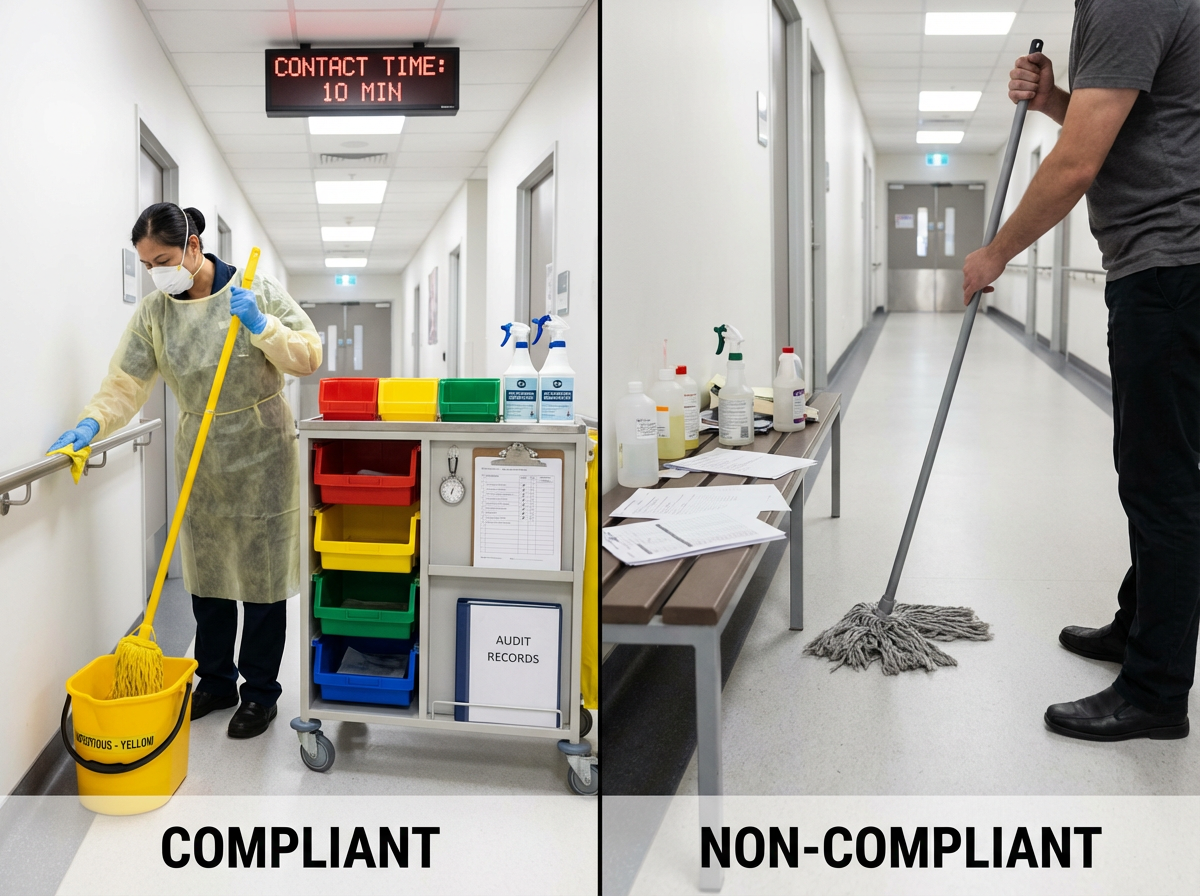
Healthcare facilities across Western Australia operate under some of the most rigorous hygiene regulations in the country. Compliance is not about appearance; it is about preventing healthcare-associated infections (HAIs), protecting vulnerable patients, and meeting the standards set by the Australian Commission on Safety and Quality in Health Care.
The difference between compliant and non-compliant cleaning often comes down to three elements: using the correct products, applying proven processes, and maintaining detailed documentation. These three factors form the foundation of a compliant, safe, and sustainable cleaning programme.
What WA Healthcare Regulations Require
The Australian Guidelines for the Prevention and Control of Infection in Healthcare establish national standards for medical and care facilities. These mandatory guidelines define the cleaning and disinfection process for different areas, contact time requirements, and the separation between cleaning, sanitising, and disinfecting.
In addition, Western Australia’s Department of Health enforces further regulations. Facilities must maintain documented cleaning schedules, use TGA-approved disinfectants, and train cleaning staff to understand the distinctions between cleaning, sanitising, and disinfecting.
Cleaning removes visible dirt and organic matter. Sanitising reduces bacterial levels to safe limits. Disinfecting kills pathogens entirely. A spotless surface that has only been cleaned, not disinfected, still presents infection risks. Compliance inspectors examine chemical selection, contact times, and staff training records to confirm adherence to all required standards.
The National Safety and Quality Health Service (NSQHS) Standards also require every facility to maintain written protocols, regular audits, and documented evidence showing that manufacturer instructions for cleaning products are followed consistently.
Chemical Selection That Meets TGA Requirements
Healthcare settings cannot use general-purpose or industrial-grade cleaners. Only TGA-listed disinfectants are approved for clinical environments, as they are verified for hospital-level pathogen control. The Therapeutic Goods Administration lists products proven effective against organisms such as Staphylococcus aureus, Pseudomonas aeruginosa, and Clostridioides difficile.
The Comet Foaming Cleaner & Sanitiser is an excellent example of a compliant product, combining cleaning and disinfection in one process. Its performance depends on following label instructions, particularly the required wet contact time to ensure full disinfection.
A common compliance failure occurs when staff wipe surfaces too early. If a disinfectant requires three minutes of contact time but is removed after thirty seconds, pathogens remain active. Correct dwell time is a non-negotiable part of healthcare hygiene.
A Subiaco dental clinic experienced this issue after using a non-TGA product on patient chairs. The corrective training and product replacement costs were far greater than simply selecting compliant products from the beginning.
Colour-Coded Cleaning Systems
Colour-coding prevents cross-contamination between high and low-risk areas. A consistent system should be in place throughout the facility:
- Red – Toilets and urinals
- Yellow – Bathrooms and wash areas
- Green – Kitchens and food preparation spaces
- Blue – General low-risk zones
Some facilities also adopt purple for isolation areas or white for sterile environments. The essential point is consistency. Every tool, mop, cloth, and bucket must follow the same colour code.
The Enduro Microfibre Mop Head provides reliable performance for healthcare cleaning with multiple colour options. Microfibre captures particles effectively and can be laundered at high temperatures to remove residual pathogens.
Storage areas must maintain separation by colour as well. A 16L Mop Bucket used for low-risk zones must not share space with equipment from red-coded areas. Inspectors often check tool storage to confirm colour-coding protocols are observed beyond active cleaning periods.
High-Touch Surface Protocols
Door handles, call buttons, light switches, and bed rails are classified as high-touch surfaces, requiring frequent disinfection each day. The Australian infection control guidelines specify that patient care surfaces should be disinfected multiple times daily.
A Cleaning Hand Caddy stocked with disinfectant wipes or spray bottles allows quick touch-point cleaning between scheduled sessions. Each treated surface must remain visibly wet for the disinfectant’s full contact period to achieve pathogen kill.
Some facilities implement electrostatic sprayers, which deliver a fine, charged mist that wraps around surfaces for complete coverage. This technique enhances efficiency but requires trained operators and TGA-approved chemical formulations.
Clinical areas must also balance effectiveness with patient comfort, using low-residue, low-odour disinfectants that meet both performance and safety requirements.
Floor Care in Clinical Environments
Floors can act as vectors for infection spread if not properly cleaned. In clinical spaces, traditional mop-and-bucket systems often recycle contaminated water. The Polystar Orbital Floor Scrubber solves this by scrubbing, applying clean solution, and extracting dirty water in a single pass, reducing cross-contamination risk.
Flooring materials must also determine product selection. Vinyl composition tile, commonly found in corridors, requires pH-neutral cleaners that protect surface coatings. Administrative areas with timber flooring benefit from Long Life Timber Floor Polish for a safe, polished finish that resists wear.
Carpet is acceptable in non-clinical spaces if deep-cleaned regularly. The Steamvac HP Auto 2 Carpet Steamer provides hot water extraction for sanitising fibres effectively. However, most patient care areas are now designed without carpet to limit contamination risk.
Bathroom and Sanitary Area Standards
Bathrooms in healthcare facilities represent high-risk contamination zones. Cleaning in these areas must focus on disinfection as much as appearance.
Colour-coded red tools are reserved exclusively for sanitary areas. Hospital-grade disinfectants are required to target enteric pathogens such as Norovirus and C. difficile. The Oates Ergo Extra-Long Toilet Brush improves reach and coverage, reducing staff exposure to contaminated surfaces.
Cleaning must always progress from least to most contaminated areas – mirrors and dispensers first, then basins, taps, toilet exteriors, and finally bowls and floors. Shared bathrooms must be disinfected after each patient use, with terminal cleaning and photographic documentation after discharge where possible.
Equipment Hygiene and Maintenance
Even the most advanced cleaning equipment requires maintenance to remain compliant. Dirty mop heads, unclean tanks, or clogged vacuum filters can undo proper cleaning work.
The Pacvac Superpro 700 Backpack Vacuum features HEPA filtration that captures 99.97% of fine particles. Filters should be replaced on schedule to prevent airflow restriction and re-release of contaminants.
Microfibre cloths and mop heads must be washed at a minimum of 60°C without fabric softeners. Battery-powered tools such as the Pacvac Superpro 700 Battery Kit improve mobility and safety by eliminating trip hazards. Batteries should be rotated and charged according to manufacturer guidance.
Floor scrubbers and sweepers require daily tank emptying, rinsing, and drying to prevent bacterial growth. The Medusa Battery-Powered Sweeper simplifies maintenance through accessible components, supporting consistent daily upkeep.
Documentation and Audit Compliance
Compliance depends on documented proof of cleaning activities and staff training. Auditors review both the physical environment and record-keeping accuracy.
Cleaning schedules must include the task, location, responsible cleaner, time, and cleaning product used. Vague entries such as “daily clean” do not meet compliance standards.
Digital tracking systems that timestamp each task improve accuracy and accountability. Automated alerts can identify overdue tasks or incomplete cleaning areas.
Dilution records confirm that chemicals are mixed correctly. Even with automated systems, documentation ensures consistency and accountability. Training logs must show that every team member understands infection control, equipment use, and emergency procedures. Annual refreshers are mandatory.
Spill Response Procedures
Spill response is a vital part of infection control compliance. Blood, body fluid, and chemical spills require prompt and controlled response following approved protocols.
Each facility must maintain accessible blood spill kits containing PPE, absorbents, and hospital-grade disinfectants. Procedures should follow a structured order – absorb, clean, then disinfect. Only products proven effective against blood-borne pathogens should be used.
Chemical spills must be handled according to each product’s Safety Data Sheet (SDS). Staff must understand containment, neutralisation, and safe disposal processes. Every spill incident must be logged with the date, time, and confirmation that the area was cleared for safe reuse.
Building a Culture of Compliance
True compliance extends beyond documentation. It requires consistent training, dependable equipment, and a strong safety culture. Facility managers should ensure that every team member understands how proper practices protect both patients and cleaning staff.For professional guidance or tailored product recommendations, feel free toget in touch with the Weskleen team for expert assistance. To explore approved equipment and cleaning solutions suitable for healthcare environments, explore the full range of professional cleaning solutions from Weskleen Supplies.