


Blog
Reducing Ladder Risk: Why WA Facility Managers Invest in 5.5m Extension Poles

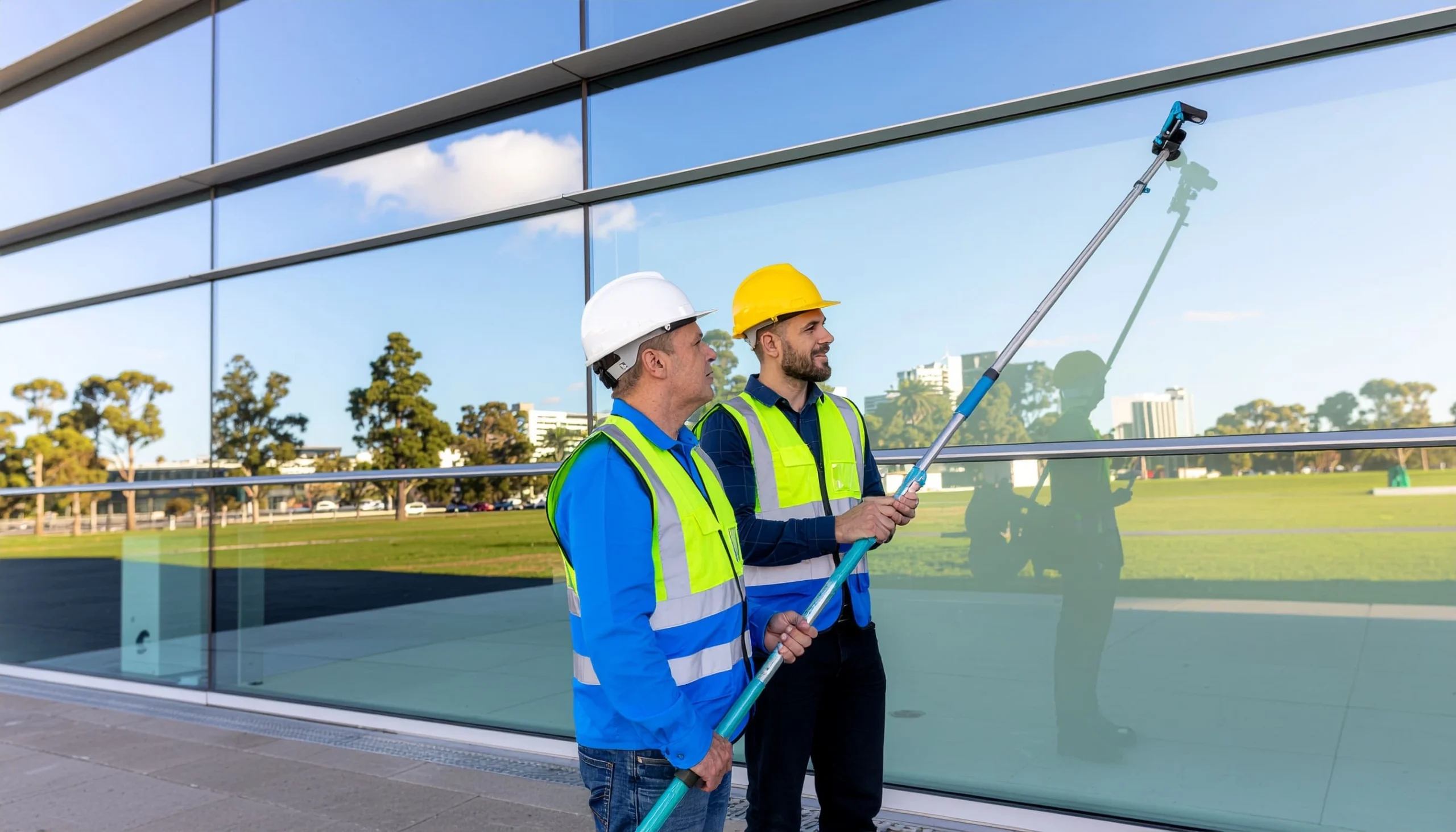
Ladders account for more than 4,000 hospitalisations across Australia each year, with falls from height representing one of the most preventable workplace injuries in modern facilities management. In Western Australia, where WorkSafe penalties for safety breaches can exceed $500,000, facility managers are no longer just thinking about clean windows, they are calculating the true cost of risk. The city’s combination of coastal salt spray, frequent dust storms, and intense UV exposure creates stubborn residue on glass surfaces that requires more than just a squeegee on a stick. When you’re working on multi-storey buildings, the right high-reach equipment does not just improve efficiency; it can mean the difference between a safe, profitable job and a costly, life-altering accident.
The shift toward ladder-free cleaning methods is not driven by simple trend-chasing. It is economics, plain and simple. When a commercial cleaner in Subiaco suffered a fractured pelvis after a ladder slipped on polished concrete in 2022, the resulting WorkCover claim, investigation costs, and productivity loss totalled over $180,000. The building manager later noted that the incident could have been avoided entirely with proper extension equipment, a lesson that cost six figures to learn. Professional-grade extension poles, particularly the 5.5-metre range, have become standard equipment in WA’s commercial sector. They are not replacing ladders in every scenario, but they are eliminating the need for them in roughly seventy per cent of routine high-access cleaning tasks. This is significant when you consider the time, supervision, and safety protocols required every time a ladder gets deployed in a public space.
The Shift Toward Ladder-Free Cleaning in WA
Most facility managers know ladders are risky. What they do not always calculate is how much that risk actually costs, even when nothing goes wrong. Consider a typical scenario: cleaning second-storey windows in a Perth office building. Using a ladder means setting up safety barriers, having a spotter present, conducting a pre-use inspection, and ensuring the surface is level and stable. That is not a five-minute job. For a task that might take ten minutes of actual cleaning, you are looking at thirty minutes of total labour when you factor in setup, supervision, and pack-down. As a leading provider of professional hygiene solutions, Weskleen Supplies understands that the unique conditions of WA require a specific approach to maintenance that prioritises both speed and safety.
Ground-level ladder free cleaning eliminates this entire equation. A cleaner with a 5.5m pole can reach those same windows from ground level, moving from one to the next without repositioning equipment, waiting for spotters, or conducting safety checks. The same forty-window job drops from twenty hours to roughly seven hours per month. That is a sixty-five per cent reduction in labour time, and a direct boost to your bottom line. But the financial argument goes deeper than efficiency. WorkSafe WA reported 847 ladder-related injuries in commercial settings between 2020 and 2023. Each incident triggers an investigation, potential fines, increased insurance premiums, and, if you’re unlucky, legal action. Even a minor injury can cost tens of thousands of dollars when you account for workers’ compensation, replacement labour, and administrative overhead.
The Financial Stake of Risk Mitigation
One Perth facility manager we work with calculated that investing in a set of height safety tools saved his operation approximately $12,000 annually in reduced insurance premiums alone. His insurer offered a discount after he demonstrated documented ladder free cleaning protocols for high-access tasks. The poles paid for themselves in five weeks. This economic reality is why successful WA businesses treat their cleaning supply cabinet as a strategic asset. By streamlining these repetitive maintenance tasks, companies can redirect their human resources toward higher-value activities that drive growth rather than managing injury claims.
Understanding Why 5.5 Metres is the Industry Standard
Not all extension poles are created equal, and length matters more than most people realise. You will find poles ranging from 1.8 metres up to 10+ metres, but the 5.5-metre extension pole has emerged as the sweet spot for WA commercial facilities. At full extension, a 5.5m pole gives a cleaner standing at ground level an effective working height of roughly seven metres when you account for arm reach. This covers second-storey windows in standard commercial buildings, high signage, and facade cleaning without being so long that it becomes unmanageable.
A ten-metre pole might sound impressive, but try manoeuvring it around obstacles, controlling it in Perth’s afternoon sea breeze, or storing it in a standard cleaning cupboard. It becomes impractical fast. The professional-grade poles we stock are built from anodised aluminium with a three-section telescopic design. It collapses down to two metres for transport and storage, which means it fits in most service vehicles and does not require specialised racks. That is critical for mobile cleaning teams servicing multiple sites across Perth’s sprawling metro area.
Engineering Rigidity for Professional Results
Weight is another factor. A quality 5.5m pole weighs roughly 1.5kg fully extended. That is light enough for a cleaner to operate overhead for extended periods without fatigue, but sturdy enough to maintain control when you are applying pressure to scrub stubborn marks. Cheaper poles often use thinner-gauge aluminium to cut costs, but they flex and vibrate during use, making precision work nearly impossible. These height safety tools must be rigid enough to transmit hand movements into clean, consistent pressure on the glass surface.
Height Safety Tools: A Strategic Investment
Western Australia’s Work Health and Safety regulations do not explicitly ban ladders, but they do require employers to eliminate risks where reasonably practicable. If a safer alternative exists, you are expected to use it. WorkSafe WA’s guidance on working at heights is unambiguous: ladders should be a last resort, not a default option. The hierarchy of controls places elimination and substitution at the top. In plain language, that means if you can do the job without working at height or by using equipment that does not require climbing, that is exactly what you are supposed to do.
Extension poles sit squarely in the substitution category. They allow cleaners to perform high-access work while maintaining three points of contact with the ground, the gold standard for stability. There is no climbing, no working from an elevated position, and no risk of the equipment tipping or sliding out from under someone. When WorkSafe inspectors visit a facility, they are looking for documented risk assessments and evidence that you have considered safer alternatives. If you are still using ladders for tasks that could reasonably be done with ladder free cleaning methods, you will need to justify that decision.
The Professional Acknowledgment of Risk
The financial stakes are real. WorkSafe WA can issue on-the-spot fines up to $7,500 for individuals and $37,500 for businesses. If a serious injury occurs and investigators determine you failed to implement reasonably practicable controls, you are looking at potential prosecution with penalties exceeding $500,000. We worked with a Fremantle facility manager who was issued an improvement notice after an inspector observed cleaners using a 3-metre ladder to dust high shelving. The inspector noted that height safety tools were readily available and would eliminate the fall risk entirely. They contacted us immediately to overhaul their equipment kit.
Complete System Integration for Facility Maintenance
The term “ladder-free” sounds straightforward, but implementation requires more than just buying a pole and hoping for the best. Professional cleaning operations build entire workflows around ladder free cleaning to maximise safety and efficiency. Start with the right attachments. A 5.5m extension pole is only as useful as what you put on the end of it. Most commercial cleaning tasks fall into three categories: window cleaning, dusting, and surface scrubbing.
For window cleaning, you want a compatible squeegee head and washer sleeve. The key is ensuring the attachment locks securely with zero play or rotation. A loose connection at six metres of height turns precision work into guesswork. Dusting high surfaces works best with microfibre or synthetic heads. The microfibre mop head and dusting systems attract and hold dust rather than just pushing it around. That matters when you’re working overhead, because the last thing you want is a cloud of dust falling onto freshly cleaned floors below.
The Role of Rigidity in Scrubbing
For scrubbing tasks like removing bird droppings or cleaning grimy facade panels, you need a brush head with enough bristle stiffness to break up deposits without scratching surfaces. This is where pole rigidity becomes critical. If your pole flexes under pressure, you cannot generate the force needed to clean effectively, and you will end up compensating with awkward body positions that lead to shoulder and back strain. Ensuring your team has the right height safety tools means they can achieve a deep clean from a position of total safety.
Case Studies: Real-World Efficiency Gains
One Perth shopping centre we supply switched their entire ladder free cleaning program to extension poles in 2023. Their cleaning supervisor told us the biggest operational change was not the equipment itself, it was training staff to work methodically from a stable ground position rather than rushing through tasks while perched on a ladder. Cleaning quality actually improved because workers felt safer and could focus on technique rather than balance.
They also discovered unexpected efficiency gains. With these methods, one cleaner could handle tasks that previously required two people (one on the ladder, one spotting). Retail environments use them for dusting high shelving and cleaning signage without disrupting customer traffic. A Joondalup shopping centre we supply uses 5.5m poles to clean skylights monthly, a task that previously required scissor lift hire at $400 per session. The poles paid for themselves in three months. Educational facilities also appreciate the safety benefits; a cleaner with an extension pole does not create a fall hazard in high-traffic corridors during school hours.
Healthcare and Infection Control
Healthcare settings have strict infection control requirements that make these methods particularly valuable. Ladders track dirt between areas and create contamination risks when moved from space to space. Extension poles can be assigned to specific zones and cleaned between uses without the complexity of sanitising ladder rails. The Comet Foaming Cleaner & Sanitiser we stock is particularly effective for this application, it is hospital-grade and can be applied with a pole-mounted spray head for high-level disinfection without aerosol drift.
Maintenance and Longevity in Coastal Environments
Not all extension poles are built for commercial use, and the difference becomes painfully obvious after a few months of daily operation. We have seen facility managers buy budget poles from hardware chains, only to replace them three times in a year because sections seize up or locking mechanisms fail. Professional-grade equipment costs more upfront, but it is engineered for durability under constant use. The Ettore extension poles we stock use anodised aluminium rather than painted metal.
Anodising creates a hard, corrosion-resistant surface that will not degrade from exposure to cleaning chemicals or salt air. A quality anodised pole will outlast a painted equivalent by many years in commercial settings. Locking mechanisms are the weak point in most poles. Cheap models use friction-based twist locks that wear out quickly. Professional height safety tools use lever-lock or flip-lock systems with metal-on-metal engagement. They maintain consistent clamping force through thousands of extension cycles, ensuring the pole remains rigid even at its maximum reach.
Ergonomics and Weight Distribution
Weight distribution matters more than total weight. A well-designed 5.5m pole balances so that the centre of gravity stays close to your grip point. Poorly designed poles are tip-heavy, forcing you to fight the weight the entire time you are working overhead. That is not just uncomfortable; it is a recipe for repetitive strain injuries. We recommend facility managers get hands-on with equipment before committing to large orders. If you are in Perth, you can test poles at our location. Feel how the sections extend and check whether the locks engage positively.
Training Teams to Work Smarter, Not Higher
Equipment is only half the equation. The real value of these systems emerges when teams are properly trained to use them effectively. Start with proper technique for overhead work. Working with an extended pole uses different muscle groups than ground-level cleaning. Cleaners need to learn to position themselves directly below the work area, use controlled movements rather than force, and take regular breaks to avoid shoulder fatigue. Ten minutes of overhead work is roughly equivalent to thirty minutes of ground-level cleaning in terms of physical demand.
Teach staff to work systematically. With ladder-based cleaning, there’s a temptation to rush because setup time is significant. Extension poles eliminate that pressure, allowing cleaners to work methodically across a surface without time penalties for moving position. Quality improves when people are not hurrying to “make the ladder time worthwhile.” Surface-specific approaches matter too; glass requires a different technique than metal panels. A squeegee on glass needs overlapping strokes and consistent pressure, whereas dusting requires light contact to avoid scratching.
The Economics of Prevention
Here is a scenario that plays out across WA facilities every month: a cleaner rushes a ladder setup, skips the stability check, and reaches too far to avoid repositioning. The ladder tips. The cleaner catches themselves, nothing breaks, and no injury occurs. But that near-miss represents a failure in your safety system, and it is only a matter of time before the same conditions produce a different outcome. WorkSafe’s incident data shows that serious ladder falls are almost always preceded by multiple unreported near-misses.
ग्राउंड-लेवल सफाई eliminates this entire risk category. You cannot fall from a ladder you are not using. It sounds obvious, but the implications are profound. When you remove fall-from-height risks, you are not just preventing injuries; you are eliminating the entire cascade of costs, investigations, and liability that follows them. Insurance companies understand this math better than anyone. Several WA-based commercial insurers now offer premium discounts for facilities that can demonstrate documented safety protocols. The discounts typically range from eight to fifteen per cent on workers’ compensation premiums.
Choosing Equipment That Actually Lasts
If you are convinced these safety methods make sense for your operation, here is what to prioritise when selecting equipment. For most WA commercial facilities, 5.5 metres hits the sweet spot between reach and manageability. Construction quality is non-negotiable; anodised aluminium should be your primary choice. Check the wall thickness of the tubes, professional poles typically use thicker gauge material. Anything thinner flexes too much under working loads.
Test the locking mechanism yourself. They should engage positively with a clear tactile click. If they feel mushy, they will likely fail under the high-pressure conditions of a Perth summer. For teams managing multiple sites, consider standardising on a single pole system. When all your equipment uses the same attachment interface, you can swap heads between poles without compatibility issues. This simplifies inventory management and means a broken pole does not sideline your entire maintenance program. Pairing your pole with a sturdy mop bucket ensures you have a mobile, centralised station for your cleaning solutions.
Ultimately, maintaining a world-class facility requires the right combination of strategy, staff training, and high-performance hardware. By treating high-reach maintenance as a specialised skill rather than a generic task, you reduce long-term costs and create a better outcome for your clients. This proactive approach ensures that your reputation is never hindered by accidents or equipment failure. A safe facility is the clearest indicator of a healthy, productive business that is ready for the future.
If you are struggling with persistent safety concerns or are looking to upgrade your current maintenance protocols, we invite you to connect with us at 1800 728 926 today. Our team of experts can help you select the ideal equipment for your specific building types and surface materials. We understand the unique challenges of the WA commercial landscape and provide tailored solutions that work in the real world. For all your professional cleaning needs, trust Weskleen Supplies to provide the solutions that keep WA moving forward safely. Our commitment to quality ensures that your facility remains safe, compliant, and professional-looking for years to come.