


Blog
Fast Cleaning Supply Delivery in Perth for Urgent Site Restocks

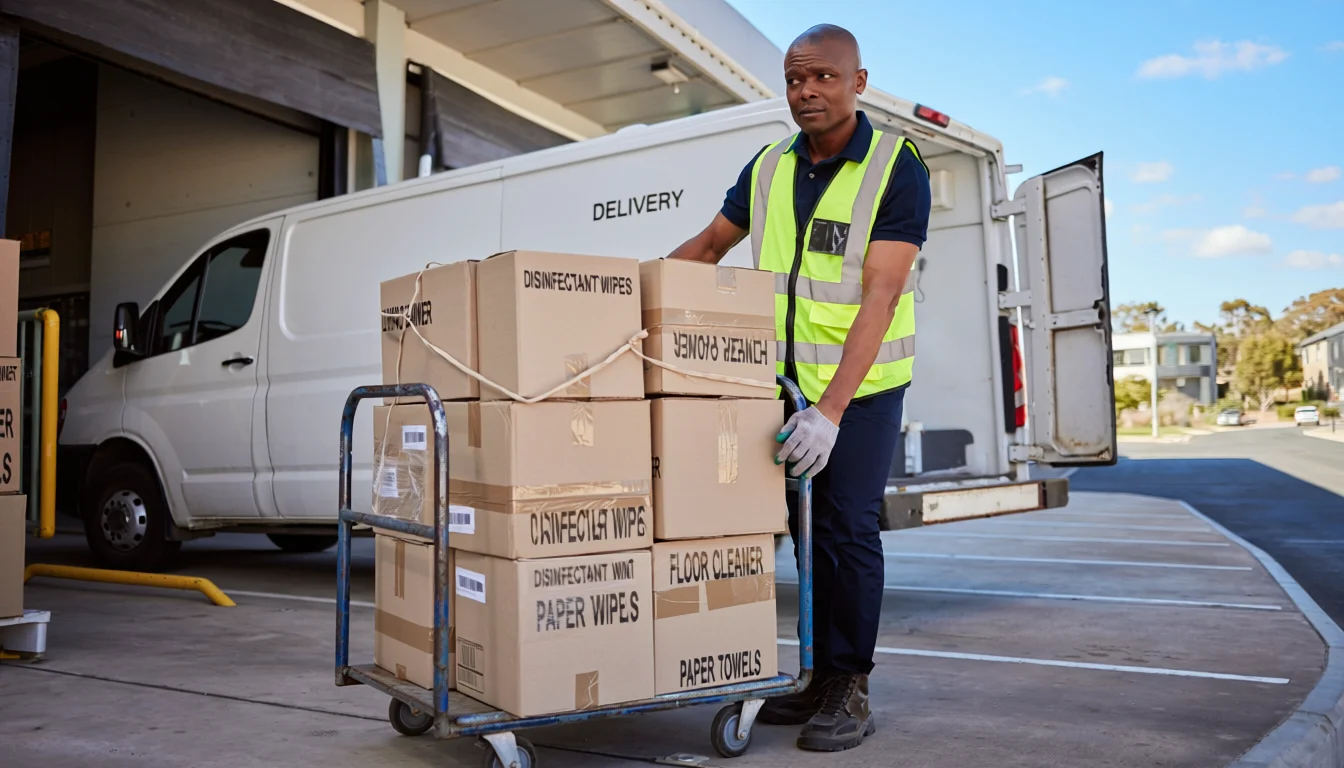
When a commercial site runs out of sanitiser mid-shift or a facility manager discovers their floor scrubber pads are depleted on a Friday afternoon, the clock starts ticking. Production halts. Cleaning schedules collapse. Staff stand idle. In Perth’s competitive commercial landscape, where hygiene standards aren’t negotiable and downtime costs real money, access to rapid cleaning supply delivery isn’t a luxury; it’s operational infrastructure.
Professional cleaning operations face a unique pressure point that retail environments never encounter: the products they rely on aren’t optional extras that can wait until next week’s order. They’re the difference between meeting contractual obligations and breaching service agreements. A school can’t delay reopening because disinfectant didn’t arrive. A food processing facility can’t pause production while waiting for replacement mop heads. The supply chain for commercial cleaning materials needs to function with the same reliability as the cleaning work itself.
Why Standard Delivery Timelines Fail Commercial Operations
Traditional wholesale suppliers often operate on predictable but inflexible schedules – weekly deliveries, minimum order values, or regional routes that prioritise volume over urgency. This model works perfectly for planned restocking, but it collapses the moment reality intervenes.
A contract cleaner might arrive at a multi-storey office complex to discover their team used the last drum of floor cleaner two days earlier than projected. A facilities manager could face an unexpected health inspection with depleted sanitiser stocks. A maintenance crew might burn through scrubbing pads faster than anticipated when tackling a particularly stubborn buildup. These aren’t failures of planning; they’re the inevitable friction of real-world operations meeting theoretical schedules.
The cost of waiting isn’t just inconvenience. It’s measured in labour hours paid to staff who can’t work, penalties for missed service windows, and the reputational damage of explaining to clients why standards slipped. When a commercial kitchen runs out of heavy-duty degreaser during dinner service prep, the chef doesn’t want to hear about next Tuesday’s delivery route. Reliable cleaning supply delivery in Perth becomes not a logistical convenience but a genuine operational necessity.
What Bulk Janitorial Stockists in WA Actually Stock for Emergency Orders
The term “bulk janitorial stockists” suggests warehouses full of generic cleaning products, but the reality is far more nuanced. Professional operations don’t just need any cleaning supplies – they need specific formulations, compatible equipment parts, and products that meet particular compliance standards.
A quality stockist maintains inventory depth across multiple categories simultaneously. Chemical concentrates in 15-litre and 20-litre drums for dilution systems. Microfibre cloths in colour-coded sets for cross-contamination prevention. HEPA filter replacements for specific vacuum models. pH-neutral floor cleaners that won’t damage sealed surfaces. Food-safe sanitisers with the appropriate Australian Standard certifications.
This isn’t about having one type of mop bucket. It’s about stocking the 16L mop bucket that fits a commercial wringer system, alongside replacement wringers, compatible microfibre mop heads, and the extension handles that work with a facility’s existing equipment.
Consider the difference between consumer-grade and professional-grade inventory. A hardware store might stock a single type of all-purpose cleaner. A proper janitorial stockist carries pH-specific formulations for different surfaces, concentrated versions for automated dispensing systems, and ready-to-use variants for spray-and-wipe applications. They’ll have both the Mr. Bean 5L all-purpose cleaner for general maintenance and specialised products like food-safe Comet foaming cleaner and sanitiser for high-hygiene environments.
Equipment parts represent another critical inventory category. When a backpack vacuum’s motor housing cracks or a floor scrubber’s brush assembly wears out, operations can’t wait for manufacturer shipping. Stockists who understand commercial needs maintain parts for popular models – battery packs for cordless equipment, replacement squeegees for window cleaning kits, and brush attachments for various floor types.
How Perth’s Geography Creates Unique Supply Chain Challenges
Perth’s isolation isn’t just a talking point – it’s a logistical reality that shapes every aspect of commercial supply. The city sits roughly 2,100 kilometres from Adelaide, separated from Australia’s eastern manufacturing and distribution hubs by vast stretches of desert. This distance means products shipped from Sydney or Melbourne face transit times measured in days, not hours.
For commercial cleaning operations, this geography creates a vulnerability that doesn’t exist in more connected markets. A Brisbane-based facility manager can often arrange same-day courier delivery from multiple suppliers. A Melbourne contractor has access to dozens of stockists within a 30-kilometre radius. Perth operators face a different calculation: local inventory matters because alternatives are days away.

The metropolitan area’s sprawl compounds this challenge. A cleaning company based in Joondalup might service clients from Yanchep to Fremantle – a north-south span of roughly 90 kilometres. When a site in Mandurah runs short on supplies, the team can’t easily divert stock from a northern job without burning hours in transit.
This is why bulk janitorial stockists in WA who maintain substantial Perth-based inventory solve a problem that catalogue ordering simply can’t address. When supplies are physically present in local warehouses, same-day cleaning supplies in Perth become a matter of logistics rather than interstate freight coordination.
The Real Cost of Running Out Mid-Job
Picture a commercial cleaning team arriving at a shopping centre at 10 PM for their overnight deep-clean contract. They’re scheduled to strip and recoat 5,000 square metres of vinyl flooring before the centre opens at 9 AM. Two hours into the job, they realise the floor stripper is running low – not empty, but insufficient to complete the contracted area.
The options narrow quickly. They can’t leave sections half-stripped; the inconsistent appearance would breach their agreement. They can’t return tomorrow night; the centre has scheduled maintenance for the following evening. They can’t dilute the remaining stripper further; it’s already mixed to manufacturer specifications, and weakening it would compromise effectiveness.
This is the moment when access to urgent cleaning supply delivery in Perth determines whether the company meets its obligations or faces penalty clauses. A supplier who can dispatch product within hours – not days – transforms a potential contract breach into a manageable delay.
The financial calculation is straightforward. If the cleaning crew consists of four workers at $35 per hour (including on-costs), every hour of idle time costs $140. If they wait until the next business day for standard delivery, that’s potentially 8-10 hours of downtime plus the cost of rescheduling, client relationship damage, and possible penalty fees. A $50 premium for urgent delivery suddenly looks like exceptional value.
Equipment failures create similar pressure. When a floor scrubber breaks down mid-shift, the facility doesn’t just lose cleaning capacity – it loses the ability to maintain hygiene standards that might be legally mandated. A food processing plant can’t simply postpone floor sanitation because a machine’s squeegee blade wore through. They need the replacement part immediately, not when the supplier’s next scheduled delivery arrives.
What “Fast Delivery” Actually Means for Commercial Buyers
The phrase “fast delivery” gets used so liberally in retail that it’s nearly meaningless. For consumer purchases, it might mean three-day shipping instead of five. For commercial cleaning operations in Perth, same-day cleaning supplies need to function on a fundamentally different timeline.
Same-day dispatch means orders placed before a cut-off time – often around 2 PM – leave the warehouse that afternoon. This doesn’t guarantee same-day receipt, but it ensures products enter the delivery system immediately rather than sitting in a queue until the next business day.
Express delivery options provide guaranteed timeframes – delivery by end of business, by noon the following day, or within specific four-hour windows. These services cost more because they require dedicated logistics rather than consolidated freight routes, but they solve the problem of predictability. A facility manager can plan around a confirmed 2 PM delivery in ways they simply can’t with “2-3 business days” estimates.
Local pickup availability eliminates delivery variables entirely. When a stockist maintains a Perth warehouse with will-call service, buyers can collect critical supplies within hours of ordering. This option proves particularly valuable for urgent situations where even express delivery feels too slow.
The infrastructure behind fast cleaning supply delivery in Perth isn’t visible to buyers, but it determines whether promises translate to reality. Suppliers need real-time inventory systems that prevent selling products they don’t actually have in stock. They need warehouse operations that can pick, pack, and dispatch orders within hours rather than batching them for next-day processing. They need relationships with multiple courier services to provide options when standard freight can’t meet requirements.
How to Structure Supplier Relationships to Prevent Stockouts
Reactive ordering – waiting until supplies run low before placing orders – guarantees eventual emergencies. Professional operations build supply chain resilience through structured relationships with bulk janitorial stockists in WA that balance planned restocking with emergency access.
Baseline inventory agreements establish minimum stock levels for frequently used items. A facility might commit to monthly orders of core products (floor cleaner, sanitiser, paper products) in exchange for priority access to urgent delivery when unexpected shortages occur. This arrangement benefits both parties: the supplier gains predictable revenue and can optimise inventory; the buyer secures reliable supply and emergency backup.
Janitorial supply par level systems borrow from hospitality inventory management. The buyer and supplier agree on minimum quantities for critical items – perhaps 40 litres of floor cleaner, 20 kilograms of carpet powder, and 500 microfibre cloths. When stock drops below these thresholds, reordering happens automatically. A clearly defined janitorial supply par level prevents the gradual inventory depletion that leads to mid-job shortages.
Multi-site coordination becomes crucial for companies operating across multiple locations. Rather than each site manager ordering independently, centralised purchasing can consolidate requirements, negotiate better terms, and maintain strategic reserves that can be redistributed when one location faces unexpected demand.
The relationship with a stockist should include clear communication about lead times for various products. Some items might ship from local Perth inventory with same-day availability. Others might require 2-3 days if sourced from eastern states. A few specialised products might need a week or more. Understanding these timelines allows buyers to plan appropriately rather than assuming everything can arrive overnight.
Equipment That Reduces Supply Dependency
Strategic equipment choices can dramatically reduce the frequency of urgent supply orders. Professional operations increasingly invest in systems that extend product life, reduce consumption rates, or eliminate certain supplies entirely.
Chemical dilution systems transform concentrated products into ready-to-use solutions at precise ratios. Rather than purchasing pre-diluted cleaners in spray bottles, facilities buy concentrated formulations and dilute them on-site. This approach reduces storage space requirements, lowers per-litre costs, and means a single 20-litre drum replaces dozens of spray bottles. When supply runs low, the smaller volume of concentrate needed makes urgent delivery more practical.
Battery-powered equipment eliminates the ongoing need for disposable items. Cordless vacuums like the Pacvac Superpro 700 battery kit eliminate the need for replacement bags when equipped with reusable HEPA filters, reducing both ongoing supply costs and the risk of urgent restocks.
Microfibre systems reduce chemical dependency. High-quality microfibre cloths and mop heads clean effectively with water alone for many applications, reserving chemical cleaners for genuinely soiled surfaces. A facility that previously consumed 60 litres of all-purpose cleaner monthly might reduce that to 30 litres by switching to microfibre, cutting both supply costs and the risk of running out.
Organised storage systems prevent the false emergencies caused by disorganisation. A professional cleaning hand caddy keeps supplies visible and accessible, so staff know exactly what’s available rather than discovering half-full bottles buried in storage cupboards after placing emergency orders.
The Polystar orbital floor scrubber exemplifies equipment that changes supply dynamics. Its multi-directional scrubbing action means pads last longer because wear distributes evenly rather than concentrating in specific areas. The machine’s efficiency also reduces chemical consumption – it achieves better results with less product because the mechanical action does more of the work.
Building Resilience into Cleaning Operations
Supply chain reliability ultimately comes down to redundancy and relationships. Operations that depend on a single supplier, maintain minimal inventory, and order reactively will inevitably face disruptions. Building resilience requires intentional structure.
Dual sourcing for critical items provides backup options. A facility might establish primary relationships with one stockist for most supplies while maintaining an account with a secondary supplier for emergency situations. This approach prevents complete operational paralysis if one supplier faces inventory shortages or delivery disruptions.
Strategic oversizing of storage capacity allows facilities to maintain larger reserves without creating cramped working conditions. A cleaning cupboard designed to hold exactly one week’s supplies offers no buffer for unexpected demand spikes or delivery delays. Designing storage for two weeks of typical consumption creates breathing room.
Consumption tracking transforms supply management from guesswork to data. When facilities record usage rates for key products, they can identify patterns – seasonal variations, the impact of new contracts, or gradual increases that signal growing demand. This data enables more accurate ordering and earlier warning when consumption rates change.
The relationship with suppliers should include regular communication beyond transactions. Quarterly reviews of usage patterns, upcoming facility changes, or new products that might improve operations help both parties plan more effectively. A stockist who knows a facility is adding a new building wing can ensure adequate inventory is available when cleaning operations expand.
When Premium Delivery Pricing Makes Financial Sense
Express delivery services typically cost 2-3 times standard freight rates. For routine restocking, this premium rarely justifies itself. For genuine emergencies, it’s almost always cost-effective.
Consider a scenario: a commercial cleaning company has a $2,000 contract to deep-clean a medical clinic over a weekend. On Saturday morning, they discover their sanitiser supply is insufficient to complete the job. Standard Monday delivery would mean returning the following weekend, but the clinic has scheduled patient appointments and can’t accommodate a second cleaning visit.
The company faces three options: purchase overpriced sanitiser from a retail supplier at roughly double their usual cost; breach the contract and negotiate a makeup date, risking client relationship damage; or pay $75 for same-day courier delivery of proper commercial sanitiser. The third option costs less than the first, protects the client relationship better than the second, and allows the team to complete the job as scheduled. The $75 delivery fee represents less than 4% of the contract value.
This calculation changes for low-value, non-urgent items. If a facility needs replacement toilet brushes and standard delivery arrives in two days, paying premium freight for same-day service makes no sense. The key is matching delivery speed to genuine operational need rather than treating all orders as equally urgent.
Why Local Inventory Matters More Than Catalogue Size
Online marketplaces offer astonishing product variety – thousands of SKUs available for order at any time. This breadth creates an illusion of availability that collapses under time pressure. A product listed as “available” might actually be sitting in a Sydney warehouse awaiting consolidation with other orders before freight dispatch. The “3-5 business day” delivery estimate might stretch to 7-10 days for Perth destinations.
Local inventory – physical products sitting in Perth warehouses – functions differently. When a stockist maintains substantial on-ground stock, they can dispatch orders the same day without depending on interstate freight schedules. This local presence transforms cleaning supply delivery in Perth from a complex logistics chain into a straightforward courier job.
The trade-off is that local stockists necessarily carry narrower product ranges than massive online catalogues. What they can do is maintain deep inventory of the products that commercial operations actually use regularly.
For professional buyers, this trade-off almost always favours local inventory. Weskleen Supplies maintains local stock of standard floor cleaners, sanitisers, and equipment parts – providing more practical value than browsing an online catalogue with thousands of options but uncertain delivery timelines.
Planning for the Unplannable
The paradox of supply chain management is that the most critical deliveries are, by definition, the ones you didn’t anticipate needing. If a shortage was predictable, it wouldn’t be an emergency. Building operational resilience means creating systems that function even when surprises occur.
This starts with honest assessment of consumption patterns. Most facilities have a reasonably clear picture of their baseline supply usage – the floor cleaner, sanitiser, and paper products they consume week after week. The vulnerability comes from variability: the unexpected contract extension that doubles workload, the equipment failure that increases product consumption, or the seasonal spike that strains normal supply levels.

Buffer inventory addresses this variability, but it requires balancing storage costs against disruption costs. Maintaining three months of floor cleaner inventory might eliminate any risk of shortages, but it ties up capital, requires storage space, and risks product degradation if items sit too long. Most operations find that 2-3 weeks of buffer stock for critical items provides adequate protection without excessive overhead.
The relationship with suppliers becomes the final layer of protection. When unexpected situations arise, facilities need suppliers who can respond quickly – not just with standard products, but with problem-solving. Weskleen Supplies maintains diverse inventory and flexible delivery options that transform potential crises into manageable challenges, whether the issue is a routine commercial sanitiser restock or an urgent equipment part after an unexpected breakdown.
Fast cleaning supply delivery in Perth isn’t about convenience – it’s about operational continuity. When commercial facilities face unexpected shortages, access to rapid restocking from local bulk janitorial stockists in WA determines whether cleaning schedules stay on track or collapse. The difference between adequate supply chain management and genuine resilience lies in the relationships, systems, and local inventory that enable response when standard timelines can’t meet operational reality. Professional cleaning operations don’t eliminate supply emergencies entirely, but they build infrastructure that ensures those emergencies remain manageable rather than catastrophic.
For urgent restocking needs or to discuss establishing reliable supply relationships for your commercial operation, call 1800 728 926 to explore how local inventory and flexible delivery options can support your cleaning requirements.