


Blog
Commercial Mop Selection Guide for Busy Floors

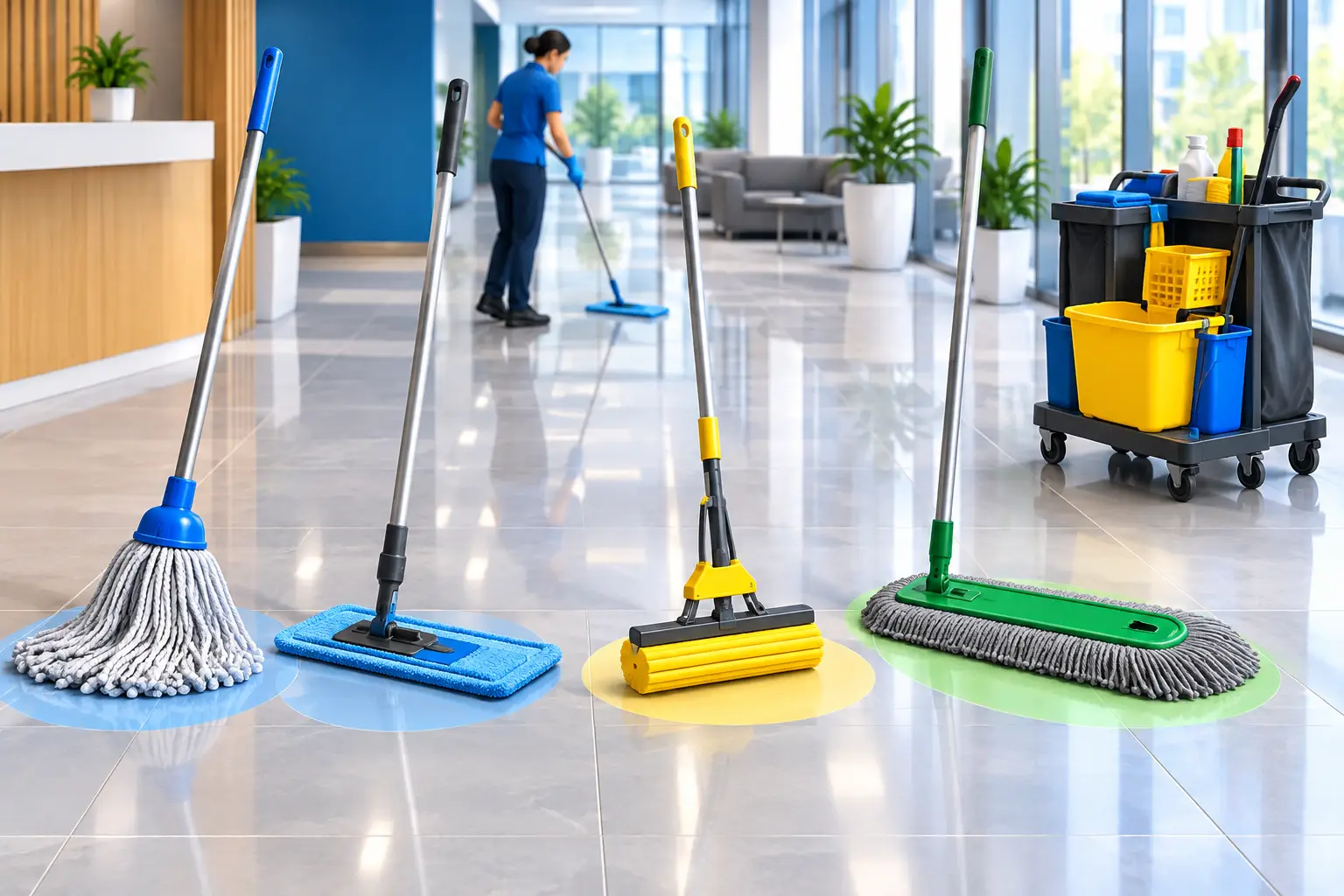
A mop that looks economical on the shelf can become an expensive choice after a few hard shifts. If it holds too much water, sheds lint, tangles in a wringer or wears out before the job is finished, your team loses time and your floors can suffer. This commercial mop selection guide helps Perth cleaners, facility managers and business owners choose equipment that suits the floor, the mess and the pace of work.
The best mop is rarely just the biggest or cheapest option. It is the one that gives staff consistent results, works with your cleaning chemicals and can be replaced easily when parts wear out. Start with the work area, then build the mop system around it.
Start with the floor and the cleaning task
Before choosing a mop head, consider what is underfoot. Smooth vinyl, sealed concrete, ceramic tiles, timber-look flooring and safety flooring all respond differently to moisture and agitation. A general-purpose mop may be suitable across several areas, but high-risk zones often need a more specific setup.
For routine damp mopping in offices, classrooms, hallways and retail spaces, a cotton or blended yarn mop is a familiar, practical choice. It carries a good volume of solution and is effective for everyday soil. The trade-off is drying time: a very wet mop can leave excess moisture behind, particularly on uneven tiles or textured surfaces.
Microfibre flat mops are often the better option for low-moisture cleaning, polished floors, healthcare settings and spaces that need a quick turnaround. Their fine fibres pick up dust and light soil effectively with less chemical and water. They are not always the best answer for heavily soiled entryways, greasy kitchen floors or large spill clean-ups, where a more absorbent mop head may do the harder work faster.
Deck scrub mops and stiff brushes have their place too. In commercial kitchens, workshops, loading areas and outdoor-adjacent spaces, built-up soil may need scrubbing before it can be lifted away. A mop should not be asked to do the job of a scrubber, floor machine or degreaser.
Choose the right mop head material
Mop head material affects absorbency, durability, release of soil and how well the mop performs after repeated laundering. The most common choices each suit a different routine.
Cotton mop heads are absorbent and cost-effective, making them a solid option for general cleaning and spill response. They are widely used in hospitality, schools and general maintenance. Cotton can take longer to dry and may deteriorate faster if left wet or washed incorrectly, so it suits sites with a reliable laundering and storage routine.
Rayon mop heads are smooth, low-lint and quick drying. They offer good release when rinsed and work well for applying disinfectant or cleaning solution evenly. They are less absorbent than cotton, which can be a benefit where controlled moisture matters but a limitation for larger spills.
Cotton-rayon blends offer a useful middle ground. They combine good absorption with better strength and quicker drying than pure cotton. For many commercial sites, a blend is a dependable all-round choice when one mop type needs to cover several daily tasks.
Microfibre is highly effective at collecting fine dust, hair and light debris. It is particularly useful for maintenance cleaning where presentation matters, such as medical practices, showrooms and offices. Buy commercial-grade microfibre pads rather than treating them as disposable items. With correct washing, quality pads can offer strong value over time.
Match mop size to the area, not just the spill
A larger mop head can cover a broad open floor quickly, but it is harder to manoeuvre around toilets, furniture, doorways and tight storerooms. Small heads are easier to control and lighter for staff, while medium and large heads improve productivity in long corridors, function rooms and open retail areas.
For cut-end yarn mops, weight is a useful guide. A lighter mop is suitable for smaller washrooms and spot work. Medium-weight heads are a practical choice for general commercial cleaning. Heavy-duty heads suit larger areas and wetter work, but only if the handle and bucket wringer can manage them properly.
Flat mops follow the same principle. A wider frame can reduce passes across an open floor, while a narrower frame makes more sense in cubicles, patient rooms and crowded spaces. Buying one size for every room may look simple, but it often slows staff down.
Your commercial mop selection guide to handles and fittings
The handle is not an afterthought. It affects comfort, control and whether your chosen mop head can be used safely. Commercial teams benefit from sturdy handles that are easy to identify, simple to replace and compatible with the mop frames or headbands already on site.
Aluminium handles are lightweight and corrosion resistant, making them a popular everyday option. Timber handles are familiar and economical, though they can become rough or absorb moisture over time. Fibreglass and composite handles can offer extra durability in demanding environments, but may cost more upfront.
Check the fitting before ordering. Screw-thread handles, clip-on systems and jaw-style clamps are not interchangeable. A mismatch can lead to improvised fixes, loose mop heads and unnecessary replacements. If you manage multiple cleaners or sites, standardising fittings makes stock control much easier.
For flat mops, look at the frame connection and pad backing. Hook-and-loop systems are quick to change, while pocket-style pads hold securely and are often preferred where consistent coverage is required. Neither is automatically better. The right choice depends on what your team can change quickly and launder correctly.
Buckets and wringers protect productivity
A mop bucket is part of the cleaning system, not just a container for water. A quality wringer removes enough solution to clean effectively without flooding the floor. That reduces slip risks, speeds drying and helps prevent streaking.
For general cleaning, a bucket and wringer combination is usually the most practical setup. Choose a capacity that suits the job and the person using it. An oversized bucket may reduce refill trips, but it is also heavier to move when full. Castors should roll smoothly and the frame should feel stable when the wringer is used firmly.
Colour-coded buckets and mop heads are worth considering in sites with washrooms, food preparation areas or infection-control requirements. Separating equipment by zone reduces the chance of transferring soil or contaminants from one area to another. The colour system only works, however, when staff training and storage practices support it.
For larger sites, a dual-bucket system can keep clean solution separate from dirty rinse water. It uses more equipment and takes up more space, but can improve cleaning consistency where floors are heavily soiled. For small offices or low-traffic venues, a simple, well-maintained bucket and wringer may be all that is needed.
Think about chemicals, hygiene and floor safety
The mop, chemical and floor finish need to work together. A neutral cleaner is generally appropriate for regular cleaning of many sealed hard floors, while a degreaser may be needed for kitchen soil. Strong chemicals used too often can dull finishes, damage some surfaces or shorten mop life.
Avoid soaking floors simply because the mop head is highly absorbent. Excess water can travel into grout lines, edges and joins, and it creates a longer slip-risk period for customers and staff. Use the correct dilution, wring thoroughly and display wet-floor signage whenever required.
In healthcare, childcare, food service and other hygiene-sensitive environments, laundering matters as much as the initial mop choice. Mop heads and pads should be cleaned, dried and stored so they are ready for the next shift. Leaving a used mop in a bucket is a fast way to create odour, bacteria growth and poor cleaning results.
Buy for the total cost of cleaning
The lowest unit price is not always the lowest operating cost. Consider how long a mop head lasts, how many washes it can handle, how quickly staff can change it and whether replacement handles, frames and wringers are readily available. A reliable system reduces downtime and avoids the frustration of replacing a whole setup because one small component has failed.
It is also sensible to keep spare mop heads and a backup handle on hand. Commercial cleaning rarely stops because a headband breaks at a convenient time. For Perth businesses that need practical advice and dependable access to cleaning consumables, WesKleen Supplies can help match mop systems to the demands of your site.
A well-chosen mop will not make every floor job effortless, but it gives your team a cleaner starting point every shift. Review the floor type, soil level, moisture needs and staff workflow, then choose equipment that makes the routine safer, faster and easier to maintain.