


Blog
How the Pacvac Superpro 700 Improves Cleaning Staff Ergonomics and Productivity

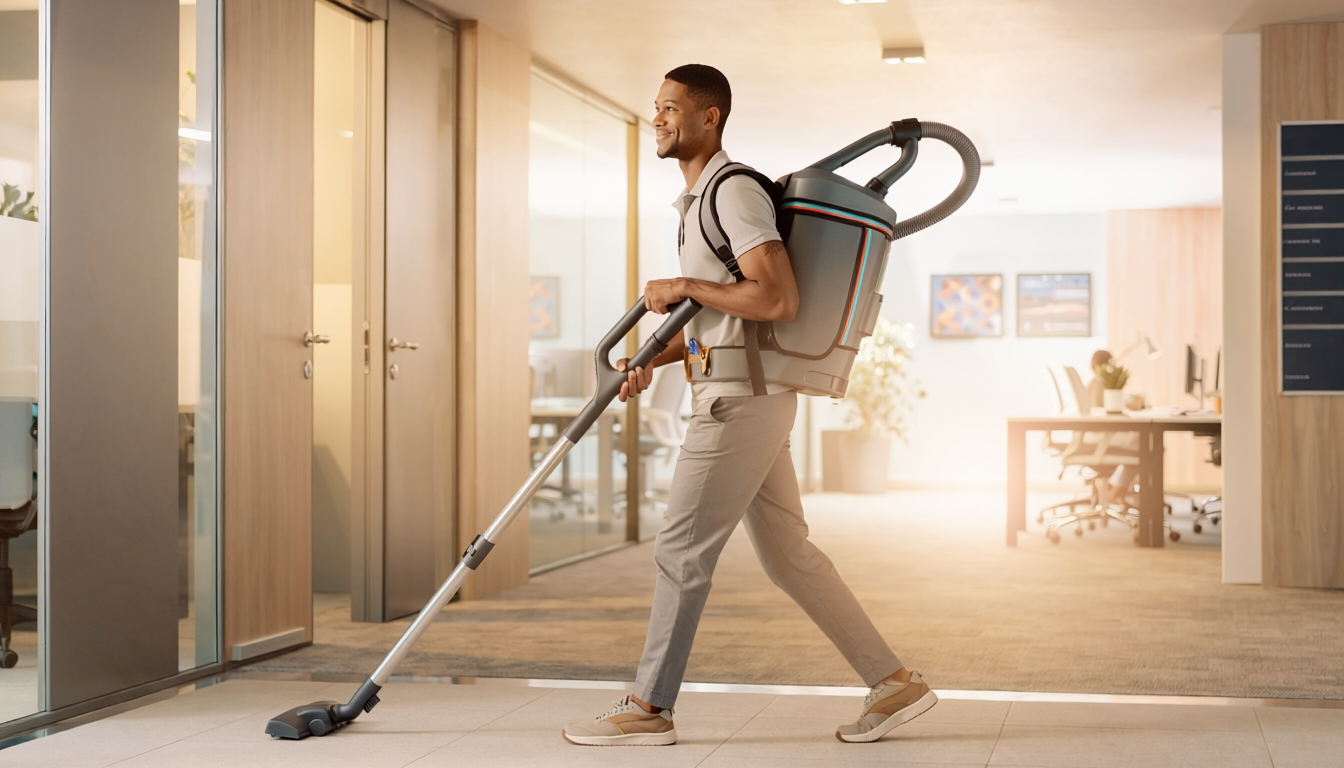
Cleaning professionals move an average of 8-12 kilometres per shift, often while carrying equipment that weighs between 5-10 kilograms. That’s roughly the equivalent of hiking a mountain trail every working day – except there’s no scenic view, just endless hallways, staircases, and tight corners.
The physical toll on cleaning staff isn’t just about sore muscles. Poor ergonomics lead to chronic back pain, shoulder strain, and repetitive stress injuries that force experienced workers off the job. In Australia, musculoskeletal disorders account for nearly 40% of workplace compensation claims in the cleaning industry. When your team is hurting, productivity drops, sick leave increases, and quality suffers.
The Pacvac Superpro 700 Backpack Vacuum was engineered to solve this exact problem. It’s not just another vacuum – it’s a complete rethinking of how commercial cleaning equipment should distribute weight, reduce strain, and help operators work faster without breaking their bodies.
Why Traditional Vacuums Sabotage Productivity
Most commercial vacuums fall into two categories: upright units that operators push and pull, or canister models that get dragged behind on wheels. Both designs create unnecessary physical stress.
Upright vacuums force cleaners into awkward postures. You’re constantly bending, twisting, and pushing against resistance. After an hour of this, your lower back starts protesting. After a full shift, you’re done.
Canister vacuums seem easier at first – just pull them along, right? But that trailing unit becomes a liability in real-world environments. It catches on furniture legs, tips over on stairs, and requires constant attention to manoeuvre. You’re always looking back, adjusting course, untangling the hose. That’s wasted motion, wasted time, and wasted energy.
Here’s what happens in practice: A cleaner assigned to a three-storey office building spends 15-20 minutes per shift just managing their vacuum – lifting it up stairs, repositioning it around desks, freeing it from obstacles. Multiply that across a team of five cleaners working five days a week. You’re losing 6-8 hours of productive cleaning time weekly.
How Backpack Design Changes Everything
The Pacvac Superpro 700 takes a different approach: wear the vacuum, don’t wrestle it.
By positioning the motor and collection chamber on the operator’s back, the ergonomic backpack weight distribution principle transfers load across the body’s strongest muscle groups – the core, hips, and legs. It’s the same principle that makes a properly fitted hiking pack comfortable even with 15 kilograms of gear. Your spine stays neutral, your hands stay free, and you move naturally.
The Superpro 700 weighs 5.3 kilograms empty. That’s lighter than most canister vacuums, and the weight sits where your body can actually handle it. The padded shoulder straps and hip belt support ergonomic backpack weight distribution by transferring load away from delicate shoulder joints onto the pelvis, which is designed to bear weight.
Compare this to pushing a 7-kilogram upright vacuum for four hours. With the upright, you’re constantly engaging your arms, shoulders, and lower back in unnatural positions. With the backpack system, those muscles relax. You’re just walking – something your body already does efficiently.
Real-World Productivity Gains
Performance data from contract cleaners who switched from traditional vacuums to the Superpro 700 shows consistent results: operators complete the same floor area 25-30% faster.
Why? Three reasons.
Uninterrupted movement. There’s no vacuum to manoeuvre around corners or lift over obstacles. You walk your route, vacuum as you go, and you’re done. One cleaner described it as “finally being able to think about the cleaning instead of fighting the equipment.”
Stairway efficiency. Stairs are where traditional vacuums kill productivity. With an upright, you’re either carrying it up each flight or vacuuming each step individually from the bottom. With a canister, you’re stopping every few steps to reposition the base unit. With the Superpro 700, you just walk up the stairs while vacuuming. The machine moves with you. A 40-step stairwell that took 8 minutes with a canister vacuum takes 3 minutes with the backpack system.
Extended operating time. Cleaning shift fatigue reduction is one of the most tangible benefits reported by operators. When equipment doesn’t exhaust your staff, they maintain consistent pace throughout their shift. The productivity drop-off that typically occurs in hours three and four diminishes significantly. Cleaners report feeling less drained at shift end, which means better quality work and fewer errors.
The Cordless Advantage: Freedom Without Compromise
The Pacvac Superpro 700 Battery Kit eliminates the last major constraint: the power cord.
Cords are productivity killers. You vacuum 10 metres, unplug, walk to the next outlet, plug in, resume work. In a large facility with limited power points, cleaners spend 10-15% of their shift managing extension cords. That’s pure waste.
The battery-powered Superpro 700 delivers 100 minutes of runtime per charge. The kit includes four batteries and a charger, which means you can operate continuously by swapping batteries during breaks. For most commercial cleaning routes, two batteries cover a full shift.
Battery power also improves safety. There’s no cord to trip over, no extension leads stretched across walkways, no risk of unplugging critical equipment in healthcare settings. In environments where multiple contractors work simultaneously – shopping centres, airports, hospitals – cordless operation reduces accidents and supports musculoskeletal cleaning injury prevention by removing the physical overhead of cord management.
One facility manager at a Perth office complex calculated that switching to cordless backpack vacuums reduced their cleaning time per floor from 35 minutes to 24 minutes. Across a 12-floor building cleaned nightly, that’s 132 minutes saved – enough to add another building to the same crew’s route.
Ergonomic Design Details That Matter
The Superpro 700 includes several features specifically engineered to reduce operator strain:
Adjustable harness system. Bodies vary. The harness adjusts for operators between 150cm and 195cm tall, ensuring proper ergonomic backpack weight distribution regardless of build. The hip belt can be tightened or loosened to shift load distribution based on individual comfort preferences.
Padded contact points. The shoulder straps and back panel use high-density foam that compresses slightly under load, conforming to body shape without creating pressure points. This matters during long shifts – poor padding creates hotspots that become painful after an hour.
Low centre of gravity. The motor and dust chamber sit low on the back, keeping the weight below shoulder level. This prevents the top-heavy feeling that causes operators to lean forward and strain their lower back.
Balanced hose design. The vacuum hose attaches at hip level and uses a swivel connector that rotates 360 degrees. This eliminates torque – the twisting force that occurs when a fixed hose pulls against your natural movement. You can vacuum in any direction without the hose fighting you.
Maintenance Simplicity Keeps Teams Working
Downtime is lost productivity. Equipment that’s difficult to maintain spends more time in the repair queue and less time earning its keep.
The Superpro 700 uses a straightforward design that cleaning staff can service themselves. The dust bag releases with a single clip. Filters are accessible without tools – just pop the cover, pull the filter, tap it clean or replace it. The entire process takes 90 seconds.
The motor is a sealed unit requiring no regular maintenance beyond keeping the intake clear. There are no belts to replace, no brush rolls to clean, no complicated mechanisms to adjust. This simplicity means less training time for new staff and fewer service calls.
For teams managing multiple units across different sites, standardising on the Superpro 700 streamlines parts inventory. You’re stocking one type of filter, one type of bag, one type of battery. That’s easier to manage than supporting five different vacuum models with unique requirements.
How It Fits into Professional Cleaning Workflows
The Superpro 700 excels in environments where cleaning staff cover large areas with varied obstacles: office buildings, schools, healthcare facilities, retail spaces, and hospitality venues.
In a typical office cleaning scenario, an operator equipped with the Superpro 700 can vacuum an entire floor – including under desks, around furniture, and along baseboards – without stopping to reposition equipment. The freedom of movement means they can follow the most efficient path rather than planning routes around power outlet locations.
For school cleaning, where teams work under tight time constraints (usually a 4-5 hour window after classes end), the speed advantage is critical. Classrooms contain dozens of chairs and desks that create obstacle courses for traditional vacuums. With a backpack system, operators weave through furniture naturally, cutting room cleaning time nearly in half.
Healthcare facilities present unique challenges: infection control requirements, sensitivity to noise, and 24/7 operations that demand cleaning around active spaces. In these environments, the Superpro 700 works alongside the SteamVac HP Auto-2 for periodic carpet extraction and Mr. Bean All-Purpose Cleaner for general surface cleaning, creating a comprehensive infection-control programme. The Superpro 700’s HEPA filtration captures 99.97% of particles down to 0.3 microns, meeting healthcare air quality standards. The relatively quiet operation at 65 decibels allows cleaning during occupied hours without major disruption. These characteristics also support musculoskeletal cleaning injury prevention by eliminating the physical overhead of cord and equipment management in tight, high-traffic spaces.
Training and Adoption: Getting Your Team on Board
Introducing new equipment sometimes meets resistance, especially from experienced cleaners comfortable with familiar tools. The transition to backpack vacuums goes smoothly when you follow a simple process.
Start with a demonstration. Let staff try the Superpro 700 on a small area – a single room or hallway. The difference becomes obvious within minutes. Most operators immediately notice how much easier it is to move and how much faster they complete the space.
Address concerns directly. The most common worry: “Won’t it hurt my back to carry weight?” This comes from experience with poorly designed backpacks. Once operators feel how the Superpro 700’s harness system distributes weight onto the hips rather than the shoulders, this concern disappears.
Provide proper fitting. Take five minutes to adjust the harness for each operator. A poorly fitted backpack negates the ergonomic benefits. The hip belt should sit on the hip bones, the shoulder straps should be snug but not tight, and the weight should feel centred.
Monitor and adjust. Check in after the first week. Some operators may need harness adjustments as they become accustomed to the system. Others might benefit from tips on optimal hose handling technique.
Most teams fully adopt backpack vacuums within two weeks. After that, few want to return to traditional systems. Weskleen Supplies provides hands-on training and harness fitting support during the transition to ensure teams get the ergonomic benefits from day one.
Cost Analysis: Investment vs. Return
The Superpro 700 costs more upfront than basic upright or canister vacuums. That’s the reality. But cost and value aren’t the same thing.
Calculate total cost of ownership over three years – the typical service life of commercial cleaning equipment. Factor in productivity gains, reduced sick leave from injury, lower maintenance costs, and decreased replacement frequency.
A cleaning contractor running a team of five operators might see:
- Productivity increase: 25% faster coverage allows the same team to service more clients or reduce overtime. Value: approximately $15,000-$20,000 annually in additional revenue or cost savings.
- Reduced injury claims: Ergonomic equipment lowers musculoskeletal injury rates. Preventing one compensation claim saves $10,000-$30,000.
- Lower maintenance costs: Simplified design reduces service calls. Estimated saving: $300-$500 per unit annually.
- Extended equipment life: Durable construction means the Superpro 700 often outlasts cheaper alternatives by 1-2 years.
The equipment pays for itself within 8-12 months for most commercial operations. After that, it’s pure value.
Integration with Other Professional Tools
The Superpro 700 works alongside other professional-grade equipment to create efficient cleaning systems. Pair it with quality squeegees and mops for hard floor maintenance, schedule periodic deep extraction with carpet cleaning equipment, and add Comet Foaming Cleaner & Sanitiser for surface disinfection in hygiene-critical spaces, and you’ve built a complete facility cleaning system.
For facilities requiring both vacuum cleaning and floor scrubbing, the backpack vacuum handles daily maintenance while floor scrubbers tackle periodic deep cleaning. This division of labour optimises both time and results – quick daily vacuum passes prevent dirt accumulation, while scheduled scrubbing maintains floor finish.
In environments with mixed flooring, operators can switch between the Superpro 700 for carpeted areas and dust control mops for hard surfaces without changing equipment carts or setups.
Making the Switch: What to Expect
If you’re currently using traditional vacuums and considering the transition to the Superpro 700, here’s what the process typically looks like:
Week 1: Initial adjustment period. Operators get accustomed to wearing the vacuum and develop efficient movement patterns. Productivity may not increase immediately as muscle memory adapts.
Weeks 2-3: Efficiency gains become apparent. Operators complete routes faster, cleaning shift fatigue reduction becomes noticeable, and any harness fit issues get resolved.
Week 4 onwards: Full integration. The backpack system becomes the new normal, and teams notice the difference compared to traditional equipment.
The Bottom Line on Cleaning Staff Productivity Tools
Commercial cleaning is physically demanding work that deserves equipment designed to reduce strain, not add to it. The Pacvac Superpro 700 represents a fundamental improvement in how cleaning professionals approach their work – not through gimmicks or unnecessary features, but through thoughtful ergonomic design that makes the job genuinely easier.
When your staff move faster, work more comfortably, and maintain consistent quality throughout their shifts, everyone benefits. Clients get better results, workers experience less physical stress, and businesses improve their operational efficiency.
If you’re ready to upgrade your team’s equipment or want to discuss how the Superpro 700 fits your specific cleaning requirements, reach Weskleen Supplies on 1800 728 926 for personalised advice based on your operational needs.