


Blog
Transitioning Your Commercial Cleaning Fleet to Battery Power

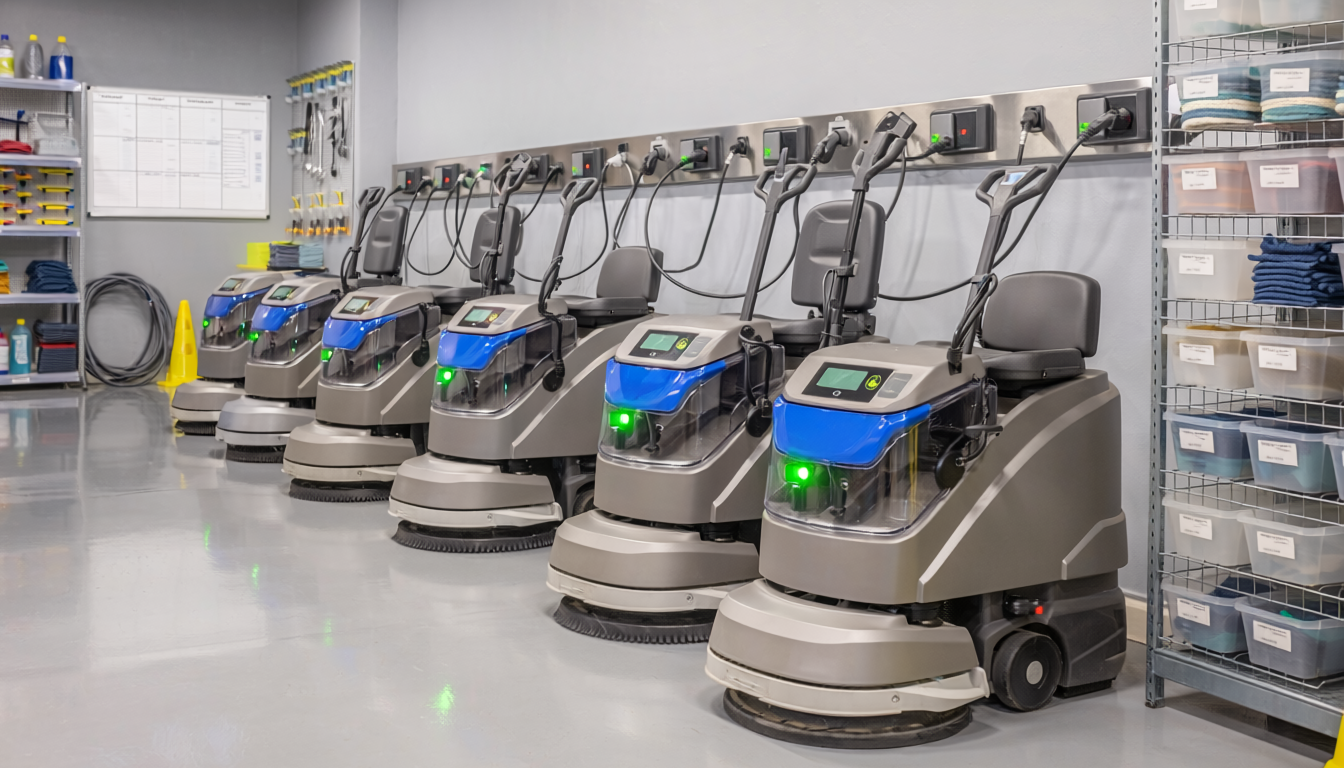
The cordless revolution isn’t coming to commercial cleaning – it’s already here. Walk into any large facility, hospital, or office complex today and you’ll notice something different about the equipment: fewer power cords snaking across floors, less time spent searching for outlets, and cleaning teams moving with a speed that corded machines simply can’t match.
For facility managers and cleaning contractors, the question has shifted from “Should we go cordless?” to “How do we transition our entire fleet without disrupting operations or blowing the budget?” The answer requires more than just swapping out equipment. It demands a strategic approach that considers runtime requirements, charging infrastructure, and the real-world demands of your specific cleaning environment.
Why Battery-Powered Equipment Has Reached the Tipping Point
Battery technology has fundamentally changed over the past five years. Lithium-ion cells now deliver runtime that matches or exceeds a typical cleaning shift, while maintaining consistent suction power throughout the discharge cycle. This wasn’t true even three years ago, when first-generation cordless commercial vacuums would lose performance as batteries depleted.
The Pacvac Superpro 700 Battery Kit exemplifies this evolution. With four batteries and intelligent charging systems, cleaning teams can work continuously without the productivity loss that plagued earlier cordless models. One battery charges while another powers the equipment – a simple rotation system that eliminates downtime entirely.
Modern battery-powered cleaning equipment delivers three critical advantages:
- Consistent power output from full charge to final minutes, unlike older NiCad technology that faded progressively
- Rapid charging cycles that fully replenish batteries in 2-3 hours, enabling mid-shift swaps if needed
- Extended lifespan of 1,000+ charge cycles when properly maintained, spreading cost over multiple years
But what does this mean for your bottom line? Consider a medium-sized office building requiring three hours of daily vacuuming. A corded team spends roughly 15-20% of their time managing cables – unplugging, moving to new outlets, untangling cords from furniture. That’s 35-45 minutes of non-productive time every single day. Multiply that across a week, a month, a year, and you’re looking at hundreds of lost labour hours.
Calculating the True Cost of Transition
Here’s where many facility managers stumble: they compare the purchase price of corded versus cordless equipment and baulk at the difference. A Pacvac Superpro 700 Backpack Vacuum with battery system costs more upfront than its corded equivalent. That’s undeniable. But this comparison misses the operational reality.
The real cost equation for battery-powered cleaning equipment includes:
- Labour efficiency gains from eliminating cord management and outlet-hunting
- Reduced workplace injuries from trip hazards (insurance premium implications matter)
- Faster room turnover in hotels, medical facilities, and schools where speed determines capacity
- Lower maintenance costs from fewer damaged cords and worn power connections
A cleaning contractor recently transitioned a 15-person team to cordless backpack vacuums. The initial investment was significantly higher than replacing their corded fleet. Within seven months, that difference had been recovered through faster job completion times that allowed them to take on two additional contracts without hiring more staff. The equipment paid for itself, then became pure profit.
Think of it like this: a corded vacuum is a landline phone. It works perfectly well for making calls, but you’re tethered to one spot. A battery-powered commercial vacuum is a smartphone – you’ve got the same core function with mobility that opens up entirely new ways of working.
Building Your Fleet Battery Transition Timeline
Don’t attempt to convert your entire fleet overnight. Even well-capitalised operations benefit from a phased fleet battery transition timeline that allows teams to adapt to new equipment while maintaining service levels.
Month 1-2: Pilot Programme
Start with your most mobile cleaning scenarios – large open areas, multi-floor buildings, or sites with limited outlet access. Deploy 2-3 cordless units and track specific metrics: time to complete standard tasks, battery runtime in real conditions, and operator feedback on ergonomics and performance.
This pilot phase reveals site-specific challenges before they become fleet-wide problems. You might discover that your cleaning schedule requires three battery rotations instead of two, or that certain high-traffic areas need machines with larger dust capacity to match the extended runtime.
Month 3-4: Infrastructure Development
While piloting equipment, establish your charging infrastructure. This isn’t as simple as plugging in a few chargers. You need dedicated charging stations that protect batteries from damage, provide adequate ventilation, and integrate with your equipment storage systems.
Designate specific areas with sufficient electrical capacity to charge multiple batteries simultaneously. A team of five using battery-powered equipment with four batteries each requires charging capacity for 20 batteries – that’s a significant electrical load that may require dedicated circuits.
Month 5-8: Staged Fleet Conversion
Begin replacing corded equipment as it reaches natural replacement cycles or when specific sites demonstrate clear ROI from cordless operation. Prioritise locations where the efficiency gains are most dramatic – multi-storey buildings, facilities with stringent safety requirements, or contracts with tight time windows.
Keep some corded backup equipment during this transition period. Battery systems are remarkably reliable, but having fallback options prevents a single equipment failure from derailing an entire cleaning schedule.
Training Your Team for Maximum Battery Life
The most expensive battery system becomes worthless if operators don’t understand proper care and handling. Battery longevity depends heavily on charging habits, storage conditions, and usage patterns.
Essential training points for battery-powered cleaning equipment include:
- Never fully deplete lithium-ion batteries – recharge when they reach 20-30% capacity
- Store batteries in climate-controlled environments – extreme heat or cold degrades cell performance
- Rotate batteries evenly to distribute charge cycles across your entire battery inventory
- Clean battery contacts regularly to maintain efficient power transfer
One facility manager experienced first-hand what happens when these protocols aren’t followed: their battery investment failed within 18 months because cleaners would leave depleted batteries on the charger for days at a time. Lithium-ion batteries don’t have “memory effect” like older technologies, but they do suffer from poor charging habits. Overcharging generates heat that degrades internal components, while storing fully charged batteries for extended periods accelerates capacity loss.
Assigning battery management responsibility to a specific team member – someone who monitors charge levels, tracks battery performance over time, and ensures proper rotation – prevents expensive premature battery replacement. This isn’t a full-time job, but it does require consistent attention. Weskleen Supplies can advise on battery management systems suited to your fleet size during the transition process.
Integrating Cordless Equipment Across Different Cleaning Applications
Battery power isn’t just for vacuums anymore. The technology has expanded to nearly every category of commercial cleaning equipment, each with specific considerations for fleet integration.
The Medusa Battery-Powered Sweeper demonstrates how cordless technology transforms battery sweeper warehouse application and large retail floor maintenance. These machines cover vast areas without the operational complexity of corded sweepers that require constant outlet access or the fuel management of petrol-powered alternatives.
For deep cleaning applications, equipment like the Steamvac HP Auto 2 Carpet Steamer shows where battery technology still faces limitations. High-heat applications and water heating require substantial power that current battery systems can’t efficiently deliver for extended periods. These remain areas where corded equipment maintains clear advantages — as does the Polystar Orbital Floor Scrubber for periodic hard floor deep scrubbing, where consistent mains power enables precision results that current battery systems cannot replicate.
The practical approach combines technologies strategically:
- Battery-powered cleaning equipment for routine daily cleaning, high-mobility applications, and noise-sensitive environments
- Corded equipment for stationary deep-cleaning tasks, unlimited-runtime requirements, and maximum power applications
- Floor scrubbers and dust control mops as the non-battery components of a modern cleaning fleet, complementing cordless vacuums and sweepers
- Hybrid strategies that use cordless for primary cleaning with corded backup for specialised tasks
This isn’t about favouring one technology – it’s about matching equipment capabilities to operational requirements.
Managing the Charging Infrastructure Challenge
Your charging setup determines whether battery-powered equipment enhances productivity or creates new bottlenecks. Poor charging infrastructure turns the cordless advantage into a logistical nightmare.
Design your charging stations around these principles:
Centralised versus distributed charging depends on your operational model. Centralised stations at a main facility work well for teams that return to a single location. Distributed charging at multiple sites suits operations with permanent staff at various locations.
Adequate electrical capacity isn’t negotiable. Each fast-charger draws 2-3 amps – a bank of ten chargers requires a dedicated 30-amp circuit. Consult with a qualified electrician before installing charging infrastructure to ensure your electrical system can handle the load without tripping breakers or creating fire hazards.
Organised storage systems prevent the chaos of loose batteries scattered across supply rooms. Wall-mounted charging racks keep batteries secure, properly ventilated, and clearly labelled for rotation tracking. A well-organised cleaning hand caddy system applies the same principle – organised storage saves time and prevents equipment damage.
Environmental controls matter more than most operators realise. Batteries charging in a poorly ventilated storage room can reach temperatures that degrade performance and create safety risks. Ensure charging areas have adequate airflow and maintain moderate temperatures year-round.
Measuring Success Beyond Purchase Price
Six months after transitioning to battery-powered equipment, how do you know if the investment delivered value? Establish clear metrics before you begin so you can demonstrate ROI to stakeholders who approved the capital expenditure.
Track these specific indicators:
- Time to complete standard cleaning tasks – measure before and after transition for identical spaces
- Equipment-related injury reports – cord-related trips and falls should decrease measurably
- Maintenance and repair costs – battery systems have fewer mechanical failure points than corded equipment
- Client satisfaction scores – faster, quieter cleaning often improves tenant and building user perception
- Contract capacity – can your existing team handle additional work without new hires?
A school district in Perth recently shared their transition data. After converting their cleaning fleet to battery-powered cleaning equipment, they reduced average cleaning time per classroom by 12 minutes. Across 40 classrooms cleaned daily, that’s 480 minutes saved – eight hours of labour capacity recovered every single day. That efficiency gain allowed them to add detailed sanitisation protocols without extending cleaning shifts or hiring additional staff.
The Comet Foaming Cleaner & Sanitiser they were already using became more effective because cleaners had time to let the product dwell properly before wiping – a clear example of how equipment efficiency enables better chemical performance.
Future-Proofing Your Investment
Battery technology continues evolving rapidly. The cordless equipment you purchase today will likely be surpassed by more efficient models within three to five years. This doesn’t mean you should wait for “the next big thing” – it means you should structure your transition to accommodate ongoing technological improvement.
Build flexibility into your fleet strategy:
Purchase equipment from manufacturers committed to backward-compatible battery platforms. The worst-case scenario is investing in a battery platform that becomes obsolete, forcing you to replace both machines and batteries simultaneously when you upgrade.
Standardise on as few backward-compatible battery platforms as possible across your equipment fleet. If your backpack vacuums, sweepers, and other cordless tools use the same battery system – whether for office cleaning or battery sweeper warehouse application – you can interchange batteries during peak demand and simplify your charging infrastructure.
Establish replacement cycles that align with battery lifespan rather than machine lifespan. A well-maintained commercial vacuum might last 7-10 years, but batteries typically need replacement after 3-5 years of heavy use. Budget for battery replacement as a separate line item from equipment replacement.
Making the Transition Decision
For most commercial cleaning operations, the question isn’t whether to transition to battery power – it’s when and how quickly. The technology has matured beyond the early-adopter phase into mainstream reliability that matches or exceeds corded equipment performance.
Start with an honest assessment of your current operational pain points. Are cord-related injuries a recurring insurance concern? Do tight cleaning windows limit your contract capacity? Are clients demanding quieter cleaning during business hours? These specific challenges often point directly to where cordless equipment delivers the most immediate value.
The cleaning industry has fundamentally shifted toward mobility, efficiency, and operational flexibility. Battery-powered cleaning equipment isn’t a premium option anymore – it’s becoming the baseline expectation for professional cleaning operations that compete on quality and efficiency.
Weskleen Supplies has supported this transition for contractors and facility managers over the past three years. Those who embraced cordless technology early now have competitive advantages that compound over time – faster service delivery, lower operational costs, and the flexibility to take on challenging contracts that corded equipment simply can’t handle efficiently.
Your fleet transition doesn’t happen overnight, but every month you delay represents lost efficiency and competitive disadvantage. The equipment exists, the technology works, and the ROI is demonstrable. Ready to explore how battery-powered equipment fits your specific cleaning operation? Call 1800 728 926 to discuss your fleet requirements, operational challenges, and the fleet battery transition timeline that makes sense for your business.