


Blog
Childcare Cleaning Regulations in WA: What Centres Must Follow

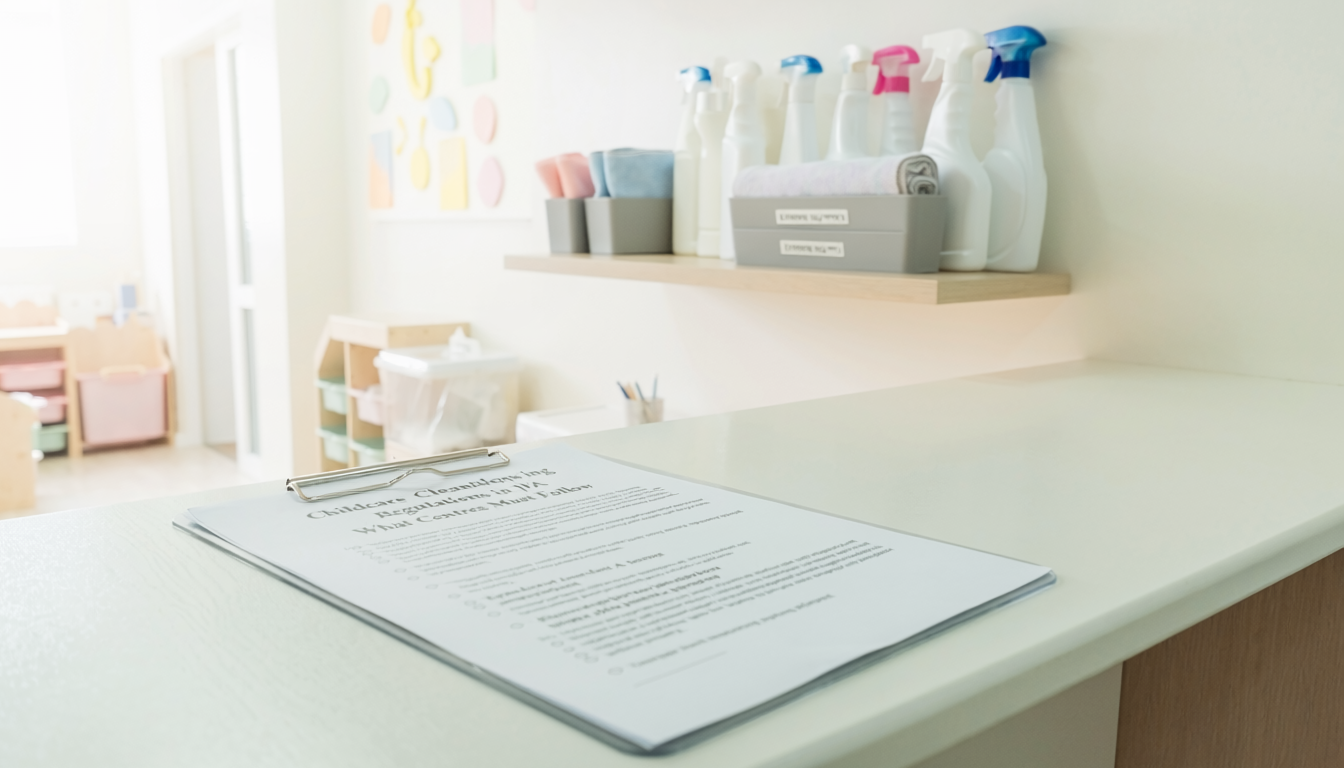
Running a childcare centre in Western Australia involves wearing many hats, educator, administrator, nurse, and chef. However, one of the most critical roles is that of hygiene manager. With immune systems that are still developing and a natural curiosity that involves putting everything in their mouths, children are uniquely vulnerable to infection.
For centre directors and approved providers, adhering to WA childcare cleaning regulations is not just about passing an assessment and rating visit. It is a fundamental duty of care. The standards set by the Education and Care Regulatory Unit (ECRU) are rigorous, and failing to meet them can lead to compliance notices, rating downgrades, or significant health outbreaks that close your doors.
At Weskleen Supplies, we help centres across Perth navigate the complex balance between hospital-grade hygiene and chemical safety. This guide breaks down exactly what is required to keep your centre compliant and your children safe.
The Regulatory Landscape in Western Australia
In WA, childcare services operate under the Education and Care Services National Law (WA) Act 2012. Specifically, Regulation 77 requires that the approved provider ensures the premises, furniture, and equipment are safe, clean, and in good repair. Regulation 103 specifically mandates that precautions must be taken to prevent the spread of infectious diseases.
While the law tells you what to do (keep it clean), it doesn’t always tell you how. For the practical application, we refer to the National Health and Medical Research Council (NHMRC) publication, Staying Healthy: Preventing infectious diseases in early childhood education and care services. This document is the bible for infection control in our sector. Assessment officers use it as the benchmark when auditing your hygiene practices.
Cleaning vs Sanitising vs Disinfecting
A common mistake we see in centres is the overuse of harsh disinfectants where simple detergent would suffice. It is vital to understand the hierarchy of hygiene.
- Cleaning: Removing dirt and organic matter with detergent and water. This removes the “food” that bacteria eat and physically washes away many germs.
- Sanitising: Reducing germs to a safe level. This is often done with heat (dishwashers) or mild chemicals.
- Disinfecting: Killing nearly all pathogens. This requires strong chemicals and is usually reserved for high-risk areas or outbreak situations.
Think of a child’s immune system like a computer without antivirus software installed yet. While we need to protect them from serious threats (malware), we don’t want to wipe the hard drive with magnets every day. Overusing hospital-grade disinfectants on low-risk surfaces (like floors in the reception area) introduces unnecessary chemical exposure to children who spend their day crawling on those floors.
High-Risk Zones: Nappy Change and Toilets
The nappy change area is the highest risk zone in any early learning centre. It is the primary vector for faecal-oral diseases like Gastroenteritis and Hand, Foot and Mouth Disease.
WA childcare cleaning regulations imply strict protocols here. The change mat must be cleaned and disinfected after every single nappy change. If a mat has cracks or tears, it cannot be effectively cleaned and must be replaced immediately.
We recommend a system where the cleaning product is within arm’s reach of the changing staff but strictly out of reach of children. Using a paper towel barrier is standard practice, but the mat underneath must still be treated. For the washrooms, small toilets and low sinks require frequent attention throughout the day, not just a once-over by the evening cleaners.
Managing Body Fluid Spills: Vomit and Blood
In early education, body fluid spills are a daily reality. However, how you clean them determines whether a single child gets sick or the whole centre goes down with a virus.
The Vomit Protocol
Vomit is biologically hazardous. If a child has Norovirus, a single vomit incident can release millions of viral particles into the air. Do not simply wipe it up with paper towels.
- Isolate: Move other children away immediately.
- PPE: Staff must glove up and wear a mask to prevent inhaling aerosolised particles.
- Contain: Use an absorbent powder (or kitty litter in a pinch) to solidify the liquid.
- Clean: Scoop up the solid matter and dispose of it in a sealed bag.
- Disinfect: Clean the area with detergent, then disinfect with a chlorine-based solution (bleach) at the correct dilution for outbreak management.
- Ventilate: Open windows to clear airborne particles.
Blood Spills
Standard precautions apply to all blood spills. Treat all blood as potentially infectious. Staff must wear gloves and clean the area with cold water first (hot water sets the protein in blood, staining the surface) before disinfecting. A dedicated “Spill Kit” containing gloves, absorbent powder, scoop, and disinfectant should be accessible in every room, not just the front office.
Food Safety and Kitchen Hygiene
Whether you have a full commercial kitchen or a small kitchenette for preparing bottles, food safety standards apply. Cross-contamination is the enemy here.
To manage this, we strongly advocate for colour-coded equipment. Using a specific mop bucket and cloth set for the kitchen (Green) that is distinct from the bathroom (Red) and general play areas (Blue) is a visual safeguard. It prevents a relief staff member from accidentally using a bathroom cloth to wipe down the high chair trays, a mistake that could have disastrous consequences.
Food safety extends to the preparation of bottles. Milk is a high-risk bacterial breeding ground. Bottle preparation areas must be sanitised before use, and any bottle brushes used must be dishwasher safe and cleaned daily.
Toy Cleaning and Shared Resources
Toys are the tools of the trade in childcare, but they are also germ transport vehicles. Unlike an office where people generally keep their hands to themselves, children share everything.
- Hard Toys (Plastic/Wood): Should be washed in warm soapy water and air-dried regularly. Many centres use a “dishwasher cycle” for suitable plastic blocks and animals.
- Soft Toys: These harbour dust mites and bacteria. They should be machine washed weekly or removed if they cannot be laundered.
- Mouthed Toys: Any toy that a child puts in their mouth must be immediately removed from circulation. It should go into a designated “yuck bucket” to be washed and disinfected before another child can play with it.
Outdoor Play Hygiene: Sandpits and Water Troughs
Hygiene standards do not stop at the back door. Outdoor play areas present unique challenges, particularly regarding organic matter and animals.
Sandpit Safety
Sandpits are a magnet for local wildlife, particularly cats, which can carry Toxoplasmosis. WA regulations require sandpits to be securely covered when not in use.
- Daily Rake: Staff should rake the sand every morning before children arrive to check for animal faeces, sharp objects, or spiders.
- Sand Churning: Regularly turning the sand over exposes the lower layers to sunlight (UV), which acts as a natural disinfectant.
- Replacement: Sand should be topped up annually and fully replaced if contamination is suspected.
Water Play
Water troughs and sensory tables are excellent for development but can quickly become bacterial soups. Water must be fresh daily. If a child sneezes into the trough or puts a water toy in their mouth, the water should be drained and the trough sanitised. Never leave standing water overnight as it attracts mosquitoes and promotes biofilm growth.
The “Green Cleaning” Dilemma vs Compliance
A growing trend in Perth childcare is the push for “toxin-free” or “green” cleaning. Parents naturally want their children exposed to fewer chemicals. However, this often conflicts with infection control requirements.
We often hear of centres using vinegar or essential oils for general cleaning. While these smell nice and are non-toxic, they are not disinfectants. Vinegar does not kill Staphylococcus, Salmonella, or the flu virus effectively.
The solution is balance. Use pH-neutral, eco-friendly detergents for general cleaning (floors, windows, low-risk surfaces) to keep the chemical load low. However, for high-risk areas (toilets, nappy change), you must use TGA-listed commercial-grade disinfectants. You cannot compromise on safety in these zones. Explain to parents that you use a “low-tox” approach for general areas but a “clinical” approach for hygiene zones to protect their children from Gastro.
Chemical Safety and Storage Protocols
The chemicals effective enough to kill Gastro are often hazardous if ingested or touched. In an environment full of curious toddlers, storage is a life-and-death matter.
All cleaning chemicals must be stored in locked cupboards or rooms. A simple latch is insufficient; it must be child-resistant. Furthermore, Safety Data Sheets (SDS) must be accessible for every product.
Staff should never carry unsecured bottles around the centre. Using a cleaning hand caddy keeps trigger sprays organised and allows the educator to place the entire caddy on a high shelf if they need to intervene with a child, ensuring the chemicals are never left unattended on the floor.
Managing Outbreaks: The Gastro Threat
Gastroenteritis is the bane of the childcare industry. It spreads like wildfire and can shut a centre down for days.
Take Lisa, a centre director in Balcatta. She prided herself on her centre’s cleanliness, yet they were hit with three gastro outbreaks in one winter. Frustrated and facing angry parents, she audited her cleaning process. She discovered her cleaners were using a “natural” eco-cleaner during the outbreak that had zero efficacy against Norovirus. By switching to a chlorine-based solution specifically for the outbreak duration and enforcing strict handwashing, she broke the cycle. The “natural” choice was noble, but in a biological warfare situation, it was ineffective.
When an outbreak is identified (usually two or more cases), you must switch from your standard neutral detergent to a disinfectant known to kill the specific bug. This often means temporarily using bleach-based solutions at specific dilution ratios until the outbreak is cleared.
Laundry and Soft Furnishings
Soft furnishings make a centre feel homely, but they hold odours and fluids. Cushion covers, dress-up clothes, and cot sheets require a rigorous laundry schedule.
Cot sheets must not be shared. If a child uses a cot, those sheets are theirs until washed. In the laundry, ensure your washing machine cycles are hot enough to provide thermal disinfection (usually above 65°C). For carpets, which act as a filter for everything that falls on the floor, professional steam cleaning should occur at least quarterly, with spot cleaning happening daily.
Documentation and Audit Evidence
You cannot just say you clean; you must prove it. During an assessment, an authorized officer will look for your cleaning schedules.
They want to see:
- Daily Checklists: Signed off by staff for opening, midday, and closing tasks.
- Nappy Change Logs: Verifying the hygiene procedure.
- Deep Clean Records: Proof of when the carpets were last steamed or the windows cleaned.
- Staff Training: Records showing educators understand infection control procedures.
This documentation feeds into your Quality Improvement Plan (QIP). Under National Quality Standard Area 2 (Children’s Health and Safety), you need to demonstrate how you are actively managing hygiene. Don’t just tick the box; use the QIP to note improvements, such as “Switched to colour-coded mops in June to reduce cross-contamination risk.”
Choosing the Right Supplies for Little Lungs
Selecting chemicals for childcare is a delicate balance. You need efficacy, but you must avoid aggressive industrial solvents that release high Volatile Organic Compounds (VOCs). Little lungs breathe faster than adults and are closer to the ground where these heavy vapours settle.
We generally recommend pH-neutral cleaners for general floor areas. A product like Mr. Bean 5L All-Purpose Cleaner is excellent for general play areas as it cleans effectively without leaving a harsh chemical residue. It strikes the right balance between professional results and a safe environment for crawling children.
Compliance in childcare cleaning is about consistency, knowledge, and using the right tools for the job. If you need help auditing your chemical cupboard or setting up a colour-coded system, contact us for expert advice tailored to the WA education and care sector.