


Blog
Food-Safe Cleaning Products for Commercial Kitchens in Perth

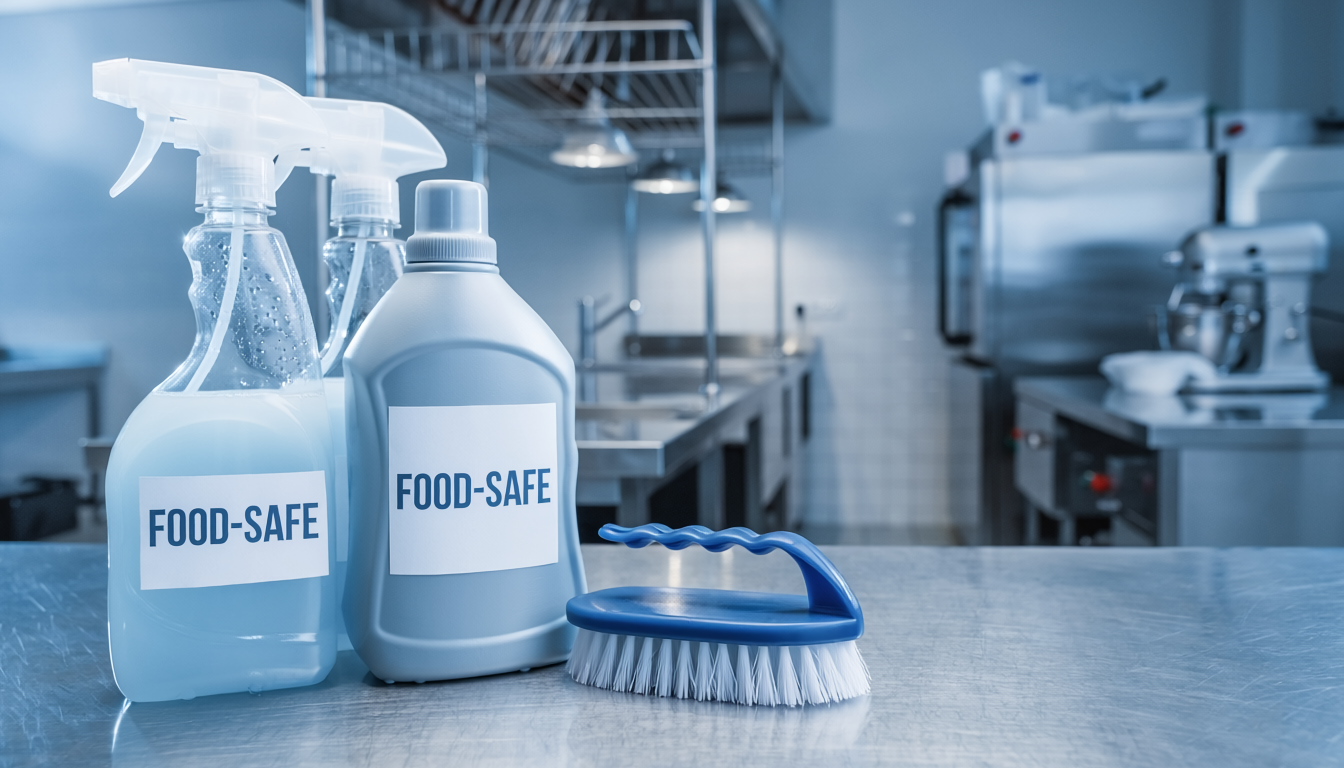
When health inspectors walk through your kitchen, they’re not just checking temperatures and storage protocols. They’re evaluating every surface, every cleaning agent, every trace of residue that might compromise food safety. One wrong product can shut down your operation faster than a spoiled batch of seafood.
The challenge isn’t simply keeping surfaces clean, t’s maintaining hygiene standards whilst ensuring that your cleaning chemicals don’t contaminate the food you’re preparing. Commercial kitchens in Perth face unique pressures: high-volume service, diverse menu offerings, strict regulatory compliance, and the constant threat of cross-contamination.
Here’s what many operators don’t realise until it’s too late: not all cleaning products marketed as “kitchen cleaners” meet food-safe standards. Some leave chemical residues that transfer to food preparation surfaces. Others lose effectiveness in the presence of organic matter. The wrong choice doesn’t just risk compliance, t risks your reputation, your customers’ health, and your livelihood.
Understanding Food-Safe Cleaning Standards
Food-safe cleaning products must meet stringent criteria set by Food Standards Australia New Zealand (FSANZ). These regulations aren’t arbitrary bureaucracy, they’re designed to prevent chemical contamination whilst maintaining the antimicrobial efficacy needed to protect public health.
A truly food-safe cleaner must satisfy several non-negotiable requirements. It needs approval for direct or indirect food contact. It must break down quickly without leaving harmful residues. The formulation should be effective against foodborne pathogens including Salmonella, E. coli, and Listeria. Most critically, it can’t alter the taste, smell, or safety of food products.
Think of food-safe cleaning products like the difference between medical-grade surgical tools and regular hardware. Both might cut, but only one is designed for safe use in direct contact with vulnerable tissue. Your kitchen surfaces, cutting boards, prep tables, slicing equipment, are in constant, direct contact with food. The chemicals you use must be formulated for this specific environment.
Many operators mistakenly believe that “natural” automatically means “food-safe.” It doesn’t. Some plant-based cleaners contain compounds that are toxic if ingested. Conversely, some synthetic formulations are specifically engineered for food safety. What matters isn’t the origin, t’s the certification, the formulation chemistry, and the residue profile.
Types of Food-Safe Kitchen Cleaners
Sanitisers vs Disinfectants
The distinction between sanitisers and disinfectants confuses many kitchen managers, yet it’s crucial for compliance and effectiveness. Sanitisers reduce bacterial counts to safe levels as defined by health codes, typically 99.999% reduction within 30 seconds. Disinfectants go further, eliminating virtually all pathogenic organisms, including viruses and fungi.
For food preparation surfaces that contact ready-to-eat foods, sanitisers are usually sufficient and preferred. They work quickly, require lower concentrations, and rinse away more easily. Disinfectants are reserved for high-risk areas: toilet facilities, waste disposal zones, and outbreak situations.
The Comet Foaming Cleaner & Sanitiser represents this sanitiser category effectively. Its foaming action increases contact time whilst clearly showing where you’ve applied it, a practical advantage during busy service periods when speed matters.
pH-Neutral All-Purpose Cleaners
Most daily kitchen cleaning doesn’t require aggressive chemicals. A quality pH-neutral cleaner handles routine soiling, grease splatters, food residue, fingerprints, without the harshness that damages surfaces or hands.
pH-neutral formulations won’t degrade stainless steel, won’t etch sealed concrete floors, and won’t irritate skin during repeated daily use. They’re the workhorses of kitchen hygiene, suitable for everything from wiping down prep tables to mopping floors between service periods.
The key advantage? They’re safe for no-rinse applications on food-contact surfaces. When properly diluted and applied, they don’t require rinsing before the surface contacts food again. This saves time and water whilst maintaining safety, a combination that matters in high-pressure commercial environments.
Specialised Degreasers
Commercial kitchens generate grease accumulation that standard cleaners can’t touch. Fry stations, grill areas, range hoods, and exhaust systems develop carbonised, polymerised grease layers that require targeted chemistry to break down.
Food-safe degreasers must balance aggressive grease-cutting power with safety requirements. They typically use alkaline chemistry, potassium or sodium hydroxide at controlled concentrations, combined with surfactants that emulsify oils. The challenge is removing stubborn grease without creating residues that transfer to food.
Take Marcus, who manages a busy fish and chip shop in Fremantle. For months, he struggled with grease buildup around his deep fryers. Consumer-grade degreasers either didn’t work or left slick residues that attracted more dirt. When he switched to a properly formulated commercial degreaser with food-safe certification, the difference was immediate. What once required an hour of scrubbing now took twenty minutes, and his surfaces stayed cleaner longer.
Key Ingredients in Food-Safe Formulations
Quaternary Ammonium Compounds (Quats)
Quats are the backbone of many food-safe sanitisers. These compounds disrupt bacterial cell membranes, causing rapid death of pathogens. They’re effective at low concentrations, remain stable in storage, and don’t corrode stainless steel, critical advantages in commercial kitchens.
The limitation? Quats lose effectiveness in the presence of organic matter and hard water. You must pre-clean surfaces before sanitising, and you might need to adjust concentrations based on Perth’s water hardness in your specific location. They also don’t work well in high-alkaline conditions, so check compatibility with your cleaning protocols.
Hydrogen Peroxide
Hydrogen peroxide has gained prominence as a food-safe oxidising agent. It breaks down into water and oxygen, leaving no chemical residue, an ideal profile for food-contact applications. It’s effective against bacteria, viruses, and fungi, including spore-forming organisms that resist other sanitisers.
The challenge with peroxide-based products is stability. They degrade when exposed to light, heat, or organic matter. They require opaque storage containers and relatively short shelf lives once opened. However, their zero-residue profile and broad-spectrum efficacy make them valuable for specific applications, particularly in organic or “green” certified operations.
Organic Acids
Citric acid, lactic acid, and acetic acid appear in many food-safe cleaners. They’re derived from natural fermentation processes, they descale mineral deposits, and they create acidic environments that inhibit bacterial growth. They’re particularly effective for removing lime scale from dishwashers and cleaning equipment that contacts dairy products.
Organic acids are genuinely food-safe, they’re the same compounds found in lemons, yoghurt, and vinegar. However, they’re not suitable for all applications. They can damage some surfaces over time, particularly natural stone and certain metals. They’re most effective in targeted applications rather than general-purpose cleaning.
Dilution Ratios and Proper Usage
Why Dilution Matters
Professional cleaning products arrive as concentrates that require precise dilution. This isn’t just about cost efficiency, t’s about safety and effectiveness. Too concentrated, and you’re wasting product, potentially leaving residues, and increasing exposure risks. Too diluted, and you’re not achieving antimicrobial efficacy, wasting time, and failing compliance requirements.
Consider dilution ratios like medication dosages. A pain reliever works at the prescribed dose. Take too much, and you risk side effects. Take too little, and you don’t get relief. Cleaning chemistry operates on the same principle, there’s an optimal concentration range where the product achieves its intended purpose safely and effectively.
Most food-safe cleaners specify dilution ratios ranging from 1:10 to 1:128, depending on the application and soil level. Heavy degreasing might require 1:10. Routine sanitising might work at 1:64. Light maintenance cleaning could use 1:128. These aren’t suggestions, they’re chemically determined concentrations where the product performs as tested and certified.
Measuring and Mixing Systems
Manual measuring invites error. Under time pressure, staff guess at dilutions, leading to inconsistent results. Proper dispensing systems, whether simple metered pumps or automated dilution stations, ensure consistency and reduce waste.
For smaller operations, colour-coded bottles with clear dilution charts work well. Designate specific bottles for specific tasks: blue for general cleaning, red for sanitising, yellow for degreasing. This visual system prevents cross-contamination and helps staff follow protocols correctly even during hectic service periods.
Larger operations benefit from wall-mounted dilution stations that automatically proportion concentrate and water. These systems pay for themselves through reduced product waste, improved consistency, and simplified training. Staff can’t mix incorrectly, they simply select the application, and the system delivers the right dilution.
Application Methods for Different Kitchen Zones
Food Preparation Surfaces
Cutting boards, prep tables, and slicing equipment require the most stringent protocols. These surfaces have direct, prolonged contact with ready-to-eat foods. Any contamination, bacterial or chemical, transfers immediately to food products.
The standard protocol is three-step: clean, rinse, sanitise. First, remove visible soil with a food-safe detergent and clean cloth. Second, rinse thoroughly with potable water to remove detergent residues. Third, apply a no-rinse sanitiser at the correct dilution and allow the specified contact time, usually 30 seconds to two minutes.
Never skip the rinse step between cleaning and sanitising. Detergent residues interfere with sanitiser effectiveness. The soap films prevent the antimicrobial agents from contacting bacterial cells. You might be following protocols but achieving inadequate disinfection because residual cleaner is blocking sanitiser action.
Cooking Equipment and Appliances
Ovens, grills, fryers, and ranges accumulate carbonised food residues and grease that require more aggressive cleaning. However, these surfaces also contact food, so you need food-safe products despite the tougher cleaning challenge.
High-heat cooking equipment often requires alkaline degreasers applied whilst the equipment is warm, not hot, to maximise chemical action. Apply the product, allow adequate dwell time for the chemistry to work (usually 5-10 minutes), then scrub and rinse thoroughly. Multiple applications might be needed for heavy buildup.
The critical point is thorough rinsing. Alkaline residues can react with acidic foods, creating off-flavours and potentially harmful compounds. After degreasing, rinse multiple times with clean water, then do a final sanitising pass before the equipment returns to service.
Floors and Drains
Kitchen floors and drainage systems harbour biofilms, complex bacterial communities encased in protective matrices. Standard mopping doesn’t penetrate these biofilms. You need products specifically formulated to break down organic matter and penetrate protective layers.
Food-safe floor cleaners must handle grease, food debris, and organic soiling whilst being safe for incidental food contact. Dropped ingredients shouldn’t be contaminated by floor cleaning residues. The Enduro Microfibre Mop Head paired with a properly diluted floor cleaner provides effective mechanical and chemical action for this purpose.
Drains require additional attention. They’re breeding grounds for bacteria, sources of odours, and potential cross-contamination vectors. Weekly or bi-weekly drain treatments with enzymatic or bacterial drain maintainers prevent buildup and control odours without the harsh chemicals that damage pipes or create fume hazards.
Common Mistakes in Kitchen Cleaning
Mixing Incompatible Products
One of the most dangerous practices is mixing different cleaning chemicals, hoping to boost effectiveness. This never works as intended and often creates hazardous situations. Mixing bleach-based sanitisers with acidic cleaners produces chlorine gas, a potentially fatal error that happens more often than it should.
Even non-hazardous combinations cause problems. Mixing an anionic detergent with a cationic sanitiser creates a chemical reaction that neutralises both products. You’re left with a useless mixture that provides neither cleaning nor antimicrobial action, though it might still look and smell like you’re cleaning effectively.
The rule is absolute: never combine products unless the manufacturers explicitly state compatibility. Use one product, rinse thoroughly if required, then use the second product. This sequential approach maintains product efficacy and prevents chemical reactions that compromise safety.
Insufficient Contact Time
Sanitisers and disinfectants aren’t instantaneous. They require specific contact times to achieve their claimed kill rates. A sanitiser might claim 99.999% pathogen reduction, but that’s only true if the product remains in contact with the surface for the specified duration, often 30 seconds to two minutes.
Spraying and immediately wiping defeats the purpose. You’re removing the chemical before it can work. The surface looks clean but remains microbiologically contaminated. This false sense of security is more dangerous than not sanitising at all because you believe you’ve addressed the risk when you haven’t.
Read and follow contact time specifications. If a product requires two minutes, keep the surface visibly wet for two minutes. This might require applying more product or using application methods that maintain wetness, foaming products, soaked cloths, or adequate spraying.
Neglecting Cleaning Equipment
Mops, cloths, brushes, and buckets become contamination vectors if not properly maintained. A dirty mop doesn’t clean, t redistributes bacteria and soils across surfaces. Filthy cleaning cloths spread contamination rather than removing it.
Establish protocols for cleaning the cleaning tools. Mop heads get laundered daily in hot water with appropriate detergent. Buckets get emptied, cleaned, and sanitised after each use, never leave dirty mop water standing overnight. Cleaning cloths get changed frequently during service and laundered properly.
The Cleaning Hand Caddy helps organise supplies and ensures fresh cloths are always available. When staff can easily access clean materials, they’re more likely to change cloths frequently rather than continuing with dirty ones.
Compliance and Documentation
Health Department Requirements
Perth commercial kitchens operate under Food Act 2008 (WA) regulations enforced by local health departments. Inspectors evaluate cleaning practices as part of overall food safety assessment. They want to see appropriate products, proper dilutions, correct procedures, and documented protocols.
Keep product safety data sheets (SDS) and product specifications accessible. Inspectors often ask to see these documents to verify that your chemicals meet food-safe standards. If you can’t produce documentation proving your products are approved for food-contact applications, you’re likely to receive violations regardless of how clean your kitchen appears.
Document your cleaning schedule and procedures. A written plan demonstrates that cleaning isn’t random or dependent on individual initiative, t’s a systematic, managed process. Include what gets cleaned, when, with which products, and who’s responsible. This documentation protects you during inspections and helps maintain consistency across shifts.
Training and Certification
Staff need training beyond “spray and wipe.” They must understand why specific products are used for specific applications, how to dilute correctly, what contact times are required, and which surfaces need which treatments. Knowledgeable staff make fewer mistakes and maintain higher standards.
Consider certification programmes like HACCP (Hazard Analysis Critical Control Points) training for key staff members. Whilst not always mandatory, these qualifications demonstrate commitment to food safety and provide structured knowledge that improves overall operations. Trained staff understand the “why” behind procedures, making them more likely to follow protocols correctly even when unsupervised.
Regular refresher training addresses skill fade and reinforces critical practices. Brief toolbox talks, five to ten minutes at shift start, can focus on specific topics: proper mop bucket preparation, sanitiser contact times, or identifying contamination risks. These frequent, focused sessions often prove more effective than annual marathon training sessions.
Selecting Suppliers in Perth
What to Look For
Your cleaning product supplier should be more than a vendor, they should be a knowledge resource. Look for suppliers who understand commercial kitchen requirements, can recommend specific products for specific applications, and provide technical support when challenges arise.
Weskleen Supplies offers the expertise and product range that commercial kitchens require. Rather than generic retail cleaning products, professional suppliers stock formulations designed for food service environments, with proper certifications and documentation.
Reliable suppliers provide consistent product availability. Running out of sanitiser isn’t an option in a commercial kitchen. Your supplier should maintain adequate stock, offer reasonable delivery timeframes, and communicate proactively about any supply disruptions. They should also be able to provide alternative products if your preferred item becomes temporarily unavailable.
Cost vs Value Considerations
The cheapest cleaning products rarely deliver the best value. Consider total cost of use, not just purchase price. A concentrated professional product might cost more per bottle but, when properly diluted, delivers more applications at lower cost per use than a retail product.
Factor in effectiveness and labour costs. A superior degreaser that removes buildup in one application saves time compared to a weaker product requiring repeated applications and extensive scrubbing. Your staff’s time has value. Products that work faster and better reduce labour costs and allow staff to focus on other critical tasks.
Product reliability matters too. Inconsistent products that sometimes work and sometimes don’t create unpredictable outcomes. You can’t maintain compliance when you can’t predict results. Premium products from reputable manufacturers deliver consistent performance batch after batch, critical for standardised operations.
Environmental Considerations
Eco-Certified Options
Many Perth kitchens seek environmentally preferable cleaning products without compromising food safety or effectiveness. This is achievable, but requires careful selection. “Green” marketing claims don’t guarantee environmental benefits or food-safe formulations.
Look for recognised certifications: Good Environmental Choice Australia (GECA), Safer Choice (EPA), or similar programmes that verify environmental claims. These certifications evaluate entire product lifecycles, manufacturing, use, disposal, ensuring genuine environmental benefits rather than superficial “greenwashing.”
Understand the trade-offs. Some eco-certified products require longer contact times or higher dilutions to match the efficacy of conventional products. This isn’t necessarily problematic, but you need to adjust procedures accordingly. Other eco-friendly formulations perform identically to conventional options, t depends on the specific product and application.
Water and Chemical Usage
Excessive water and chemical use impacts both environmental sustainability and operational costs. Efficient cleaning protocols reduce both without compromising outcomes. Proper dilution prevents waste. Microfibre cleaning tools require less chemical and water than traditional cotton materials. Automated dispensing systems eliminate overuse.
Consider water temperature strategically. Hot water enhances cleaning effectiveness but increases energy costs and environmental impact. For routine cleaning, room temperature water with appropriate chemistry often works perfectly well. Reserve hot water for applications where it genuinely improves outcomes: heavy grease removal, laundry, final sanitising rinses.
Regular equipment maintenance reduces chemical consumption. Clean equipment works more efficiently, requiring less product to achieve results. A well-maintained floor scrubber uses less water and chemical whilst delivering superior cleaning compared to manual mopping, efficiency that compounds over time.
Troubleshooting Common Kitchen Cleaning Challenges
Persistent Grease Buildup
When standard degreasing protocols fail, don’t immediately assume you need stronger chemicals. Often, the issue is application technique. Increase dwell time, allow the degreaser to work for 10-15 minutes rather than spraying and immediately scrubbing. Apply product to warm (not hot) surfaces to enhance chemical activity.
For truly stubborn carbonised grease, consider mechanical assistance alongside chemistry. Abrasive pads designed for commercial kitchens, not harsh steel wool that damages surfaces, combined with proper chemicals tackle buildup that chemistry alone can’t remove. The mechanical action exposes fresh surfaces for the chemical to attack.
Prevent future buildup through more frequent light cleaning rather than periodic intensive cleaning. Daily attention to high-grease areas prevents the polymerisation that makes grease so difficult to remove. It’s easier to wipe away fresh grease than to scrape off carbonised deposits, and it saves time in the long run.
Lingering Odours
Kitchen odours often persist despite thorough cleaning because the source isn’t visible surface soils, t’s organic matter trapped in drains, grout lines, or porous surfaces. Surface cleaning doesn’t address these hidden sources.
Enzymatic cleaners excel at odour control because they biologically break down organic matter rather than simply masking smells. Apply these products to drains, floor grout, and other areas where organic material accumulates. Allow extended contact time, overnight treatment of drains often works well.
Ensure adequate ventilation throughout cleaning processes. Stagnant air retains odour molecules. Open windows, run exhaust fans, and improve air circulation. Sometimes the “odour problem” is inadequate air exchange rather than a cleaning deficiency.
Residue and Streaking
Residue and streaking typically indicate one of three issues: insufficient rinsing, incorrect dilution, or hard water interference. If your surfaces feel sticky or filmy after cleaning, you’re leaving residue that attracts soil and harbours bacteria.
Verify your dilution ratios first. Many operators use concentrations that are too strong, leaving excess product on surfaces. More isn’t better, t’s wasteful and counterproductive. Follow manufacturer specifications precisely, using measuring tools rather than estimating.
Perth’s water hardness varies by location. Hard water interferes with cleaning chemistry, reduces foam, and causes mineral deposits. If you’re in a hard water area, you might need to adjust product selection, increase product concentration slightly to offset hardness, or implement water softening for cleaning applications.
Future-Proofing Your Kitchen Cleaning Protocols
Staying Current with Regulations
Food safety regulations evolve as scientific understanding advances and new challenges emerge. What was acceptable five years ago might not meet current standards. What’s acceptable today might be inadequate tomorrow. Build regulatory awareness into your operational culture.
Subscribe to industry publications, join professional associations like Restaurant & Catering Australia, and maintain contact with your local health department. These channels provide advance notice of regulatory changes, giving you time to adjust procedures before new requirements become mandatory.
When regulations change, don’t view compliance as a burden, see it as a competitive advantage. Early adoption of enhanced standards differentiates your operation as a food safety leader. Customers increasingly value food safety credentials. What starts as a regulatory requirement becomes a marketing asset.
Emerging Technologies
Cleaning technology continues advancing. Electrolysed water systems generate sanitising solutions on-site from salt and water, reducing chemical purchasing, storage, and disposal. UV-C sanitisation offers chemical-free pathogen control for certain applications. Automated cleaning equipment delivers consistent results with reduced labour.
Evaluate new technologies pragmatically. Early adoption brings advantages but also risks, unproven performance, high costs, limited supplier support. Wait for technologies to mature and demonstrate consistent value before committing. However, don’t ignore innovations that could significantly improve your operations.
The most valuable innovations improve outcomes whilst reducing costs or labour. A technology that achieves the same results at higher cost isn’t progress, t’s merely different. Focus on innovations that demonstrably enhance food safety, reduce environmental impact, lower operational costs, or improve worker safety and efficiency.
Making the Right Choice for Your Operation
Food-safe cleaning isn’t one-size-fits-all. Your menu, volume, equipment, and facility design influence which products and protocols work best. A high-volume fast-food operation has different needs than a fine dining restaurant, which differs from a commercial bakery or butcher shop.
Start with a thorough assessment of your specific requirements. Walk through your facility and identify distinct zones: heavy grease areas, dry storage, refrigeration, food prep surfaces, cooking equipment, floors, and customer areas. Each zone has unique challenges requiring targeted solutions.
Don’t hesitate to seek expert guidance. If you’re unsure which products best suit your needs, contact us for recommendations based on your specific operation. Professional suppliers like Weskleen Supplies can assess your needs and recommend proven solutions rather than generic retail options.
Remember that the most expensive mistake isn’t buying premium products, t’s experiencing a foodborne illness outbreak, health department closure, or reputational damage from inadequate hygiene. Food-safe cleaning products are insurance against catastrophic failure. They protect your customers, your staff, your business, and your peace of mind.
The investment in proper food-safe cleaning products and protocols pays dividends every day through consistent compliance, reduced contamination risk, enhanced staff confidence, and the assurance that your kitchen meets the highest standards of food safety. Your reputation depends on it.